
A gas pressure regulator takes whatever the supply line is doing and presents the burner with a working pressure it can rely on. The idea is simple. The difficulty is that a gas train contains a great deal between the meter and the burner head, and the network underneath is never still.
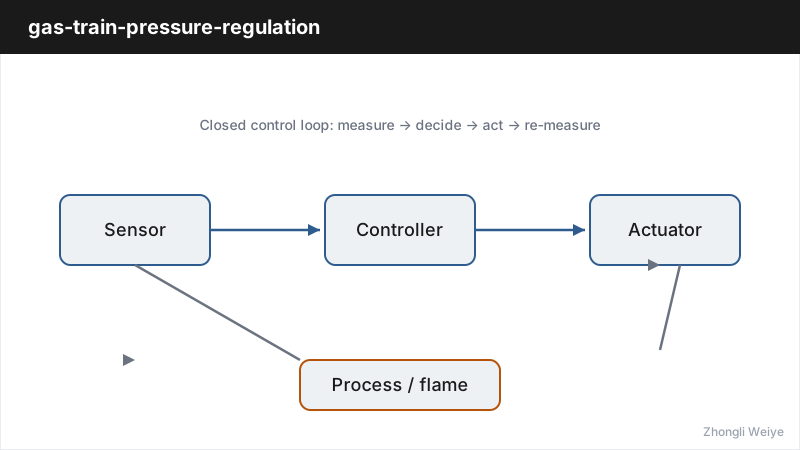
What the regulator holds constant, and what it cannot
Every regulator has an outlet pressure it tries to maintain and a range of inlet pressures over which it can manage that. Below the range it passes gas through with little correction. Above it, the diaphragm runs out of travel and the outlet rises with the inlet. Between the two sits the working band, and its width is what you are really choosing when you select a regulator.
Inside the band, outlet pressure stays close to its setpoint while the inlet moves, which keeps the valve opening steady and therefore keeps mass flow steady. What a regulator cannot do is create pressure. If the burner needs more than the train can deliver at peak demand, no adjustment closes that gap.
Sizing belongs to the burner, not to the line
The temptation is to set the regulator to match the supply. That is backwards. The figure that matters is the pressure the burner needs across its own firing range, and the regulator has to hold that while the supply moves. Set it near the top of its useful band and the burner sees healthy pressure only when demand happens to be low.
Layout upstream of the regulator matters less than most people assume, but one constraint is real. A gas train laid out in serviceable order lets a strainer be changed without cutting pipework. A strainer that can only be swapped by dismantling the line will be left in place long after it should have come out, and a loaded strainer looks remarkably like a regulator that has lost its mind.
Supply pressure sensitivity predicts real behaviour
The specification worth reading carefully is supply pressure sensitivity, which describes how far the outlet pressure moves as the inlet moves, as a proportion of that change. A well-behaved regulator holds this figure low. A poor one lets upstream movement through almost intact, and from the burner side that looks like a flame wandering for no identifiable reason.
Load sensitivity covers the other half: how outlet pressure responds to gas being drawn, so the same burner at full fire sees a different pressure from that burner at low fire. A train that behaves well at one firing rate can still disappoint at the other, which is why a burner one operator calls stable gets called unstable by the next.
Gas and air cannot be regulated in isolation
Changing gas pressure changes gas flow, and gas flow changes how much air the burner draws through the windbox and where the chamber pressure settles. A regulator that performs perfectly on its own can therefore disturb the air side every time it corrects. On a modulating burner the air damper and the fuel valve are asked to follow a curve, and a gas pressure that drifts quietly bends that curve away from what was commissioned.
This is why the pressure switches fitted in the train are set against the band the burner needs rather than the nominal supply figure. A switch that proves at the wrong point either waves through a marginal start or blocks an acceptable one.
Where regulation stops working altogether
Several faults present as poor regulation while actually being restrictions upstream. A partially blocked strainer, a pipe scaled on the inside, or a valve that is not fully open all reduce the pressure reaching the regulator, leaving it less margin to work in. The symptom is burner-side instability no setting resolves.
Combined bodies that integrate regulation, shut-off and proving into one housing save space, and they also remove the ability to separate a pressure fault from a valve fault while diagnosing. A dedicated leak test arrangement keeps those problems distinguishable, which matters more on a burner that has started locking out intermittently than the space it saves.
Commissioning proves the band under real firing conditions
Pressure measured at the supply with the burner off tells you very little. Measure at the burner inlet at low fire, then again at high fire, and watch what the instrument does while the burner modulates between them. A train that holds its band in both conditions is regulated. One that only looks steady at a single condition is not.
Write down what you measured and at what firing rate. Regulator behaviour drifts slowly, and a note showing that low fire pressure was already low last winter turns a future complaint into a short conversation.
Frequently asked questions
How much gas pressure does a burner need at its inlet?
The answer comes from the burner, not a general figure. What matters is the working band quoted across the firing range, because a pressure adequate at low fire can be inadequate at high fire once the train works against flow. Confirm that band at the burner inlet.
Why does my flame drift even though the supply pressure is steady?
A steady supply reading does not guarantee steady pressure at the burner, because everything between the two points adds its own behaviour. A loaded strainer, a partly closed valve or a long narrow pipe all sit in that gap. Measure at the burner inlet while it fires and compare against the supply reading alongside.
Does fitting a larger regulator fix an unstable flame?
Only when the cause is genuinely insufficient authority. If the real restriction is a blocked strainer or a scaled pipe, a larger regulator has less margin to give away and the symptom returns. Establish that the pressure reaching it is adequate under load.
What is supply pressure sensitivity?
The proportion of inlet pressure change that shows up as outlet pressure change. A low figure means the regulator insulates the burner from the network, which is the point of fitting one. A high figure means the flame still moves with the upstream swing.
Why does my burner lock out only at low fire?
Low fire is where the pressure margin is thinnest, so an out-of-band condition shows there first. The train may be losing pressure under low flow, or the switch setpoint may sit too close to the working pressure. Watching inlet pressure during a low fire start settles which.
Should the regulator be set to supply pressure or burner pressure?
To the burner. The supply figure tells you what is available, the burner figure what has to be delivered. Setting to the supply produces a train that works at low demand and struggles when you need it most.
Request a quote
Send the burner model plate, the fuel type and the supply pressure range at your site, and we can size a train against the working band rather than a generic chart. If the burner already runs and the issue is drift, describe the firing rate at which it appears and we will say which readings to take.
Related products
The parts and product families referenced in this guide:
- burner inlet regulator selection
- proving the regulated band at the burner
- component order from meter to burner
- vented bleed proving on a combined body
This guide covers Gas Train Pressure Regulation: Holding the Burner Steady. For the exact part that fits your duty, send us the model plate photo and we confirm availability, lead time and a matched quotation.