
An industrial oven burner rarely touches the product it is drying. It heats a moving airstream, and everything downstream depends on how evenly that airstream is distributed across the chamber width and along its length. That shifts the engineering question away from peak flame temperature and towards air side uniformity, dwell time and containment.
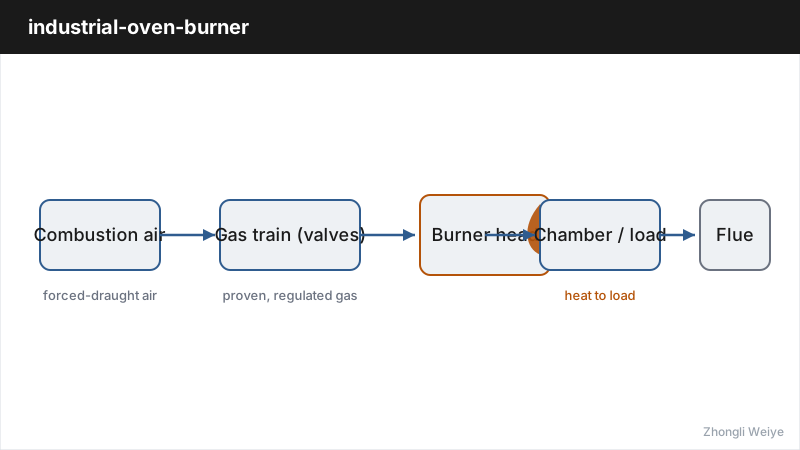
Where the heat actually lands in the chamber
A burner mounted at one end of a chamber produces a gradient, and no controller removes that gradient. The remedy is a burner arrangement matched to the geometry: linear or ribbon burners spread release along the length of a tunnel, while a single burner in a batch oven has to be supported by strong recirculation to carry heat to the far corners. Air side design is doing the work here, and the gas burner families available for oven duty differ mainly in how they release that heat into the airstream.
Recirculation fans matter as much as the burner. Fans mounted to pull rather than to push tend to keep the hot layer off the roof, where it does no useful work and adds to the load on the extract system. Where the oven handles product with a surface finish, uneven air movement shows up as a finish defect long before it shows up as a temperature complaint.
What indirect firing costs and what it buys
Direct firing puts the flame in the product airstream, which is efficient and fast. The cost is that combustion products reach the work, so anything sensitive to moisture, odour or particulate needs an indirect arrangement. A radiant tube or a heat exchanger separates them, at the price of a larger heat transfer surface and a slower warm-up.
The decision is rarely about efficiency in the abstract. It is about what the product will tolerate. Coating work that is sensitive to solvent vapour and surface contamination usually rules out direct firing regardless of how attractive the heat transfer looks. A programme controller can then hold the ramp rate and soak precisely, which matters more once the heat arrives indirectly and more slowly.
Matching dwell time rather than peak temperature
A tunnel oven runs at line speed, so the burner has to supply heat at the rate the product absorbs it, not more. Oversizing shows up as a control problem: the loop overshoots on setpoint changes and hunts, and the cure band widens because the product spends its early dwell in a chamber that is still coming up to temperature.
For a batch oven with a soak requirement, the same logic applies in the time domain. The burner capacity should match the thermal mass of the load and the refractory, because a burner that recovers temperature instantly will produce a faster ramp at the start and a slower approach at the end than the product profile allows. Sizing against average heat loss rather than peak demand is what keeps a cure reproducible from load to load.
Work with solvents and powders in the chamber
Where the process releases vapour, the oven is a containment problem before it is a heating problem. Extract has to keep the vapour concentration below its lower explosive limit at every point, which means the make-up air path and the extract path are balanced by design. A burner arrangement that creates a low-velocity dead pocket will accumulate vapour there regardless of how well the average concentration looks.
Solvent presence also constrains ignition equipment placement, and it puts a real limit on how far a hot surface can sit from the extract hood. Flame supervision should be live on every zone from the first light-off. If a gas detection layer is part of the installation, the gas leak detectors and their placement follow from the same ventilation assessment rather than from a generic layout.
Zone control and how the profile is held
Multi-zone ovens exist because a single loop cannot hold a ramp and a soak at once. Each zone gets its own thermocouple and its own modulating output, usually a servo or damper actuator driven from a three-position output on the controller. Where the oven runs at very low load, the last zone often needs an intermittent output rather than a modulating one, because most actuators cannot hold a small enough fraction of travel to keep temperature inside a narrow band.
Ambient drift is what exposes weak zone layouts. A chamber that holds its profile on a warm afternoon and drifts on a cold morning is telling you that make-up air and exhaust are not balanced, and that the burner is compensating for a moving load. Furnace pressure and the air balance around the chamber are worth examining before the burner output is changed, since no burner can correct a chamber that is breathing.
Frequently asked questions
What is the difference between direct and indirect oven firing?
Direct firing puts the flame in the airstream the product sees, which is faster and more efficient because there is no secondary heat transfer surface. Indirect firing keeps combustion products away from the product, using a radiant tube or a heat exchanger, and costs warm-up time and equipment size. The choice follows what the product tolerates, not which arrangement has the better efficiency figure.
Why are ribbon burners used in tunnel ovens?
A ribbon burner releases heat along the length of its own body rather than at a point, so the release pattern matches a moving conveyor instead of concentrating at one end. That shortens the distance heat has to travel by convection and keeps the cure band within tolerance along the full length of the oven.
How much ventilation does an oven with solvents need?
Enough to keep vapour concentration below its lower explosive limit at every point in the chamber, including the low-velocity pockets. That is a make-up air and extract balance question, not a fan size question, and it needs to hold across the whole burner output range rather than only at full load.
How is oven temperature held uniform along the length?
Through burner arrangement, recirculation fan placement and zone control together. The burner spreads release, the fans carry heat to the far end, and the zone loops adjust each section independently. Any one of the three alone leaves a gradient that the controller then has to fight.
Should an oven burner be sized for peak or average demand?
Average heat demand for the process, plus the transient needed to recover the load after a door or a line stop. Sizing on peak leaves a burner oversized for normal operation, which shows up as control hunting and a wider cure band rather than as extra capacity in service.
What information is needed to select an oven burner?
Chamber dimensions and geometry, the air side arrangement, the product and its temperature limits, the duty cycle or line speed, the fuel and its supply arrangement, and any vapour the process releases. The vapour question often changes the answer, so it is worth stating early.
Request a quote
Send the chamber dimensions, the air side arrangement and the product with its temperature limits, and we can look at how the heat release pattern matches the duty. If the problem you are describing is uneven curing across the width or drift along the tunnel, that description is more useful than a temperature figure, because it points at the air side where the fault usually sits.
Related products
The parts and product families referenced in this guide:
This guide covers Industrial Oven Burner: Even Heat for Curing and Drying. For the exact part that fits your duty, send us the model plate photo and we confirm availability, lead time and a matched quotation.