
Kiln burner design is a distribution problem before it is a temperature problem. A kiln can reach any temperature a controller asks for and the ware can still come out unevenly fired, because what determines the outcome is how evenly that temperature reaches every part of the load. That is a burner layout and air flow question long before it becomes a setpoint question. Peak heat is the easy half of the job, and it is the half most specifications concentrate on.
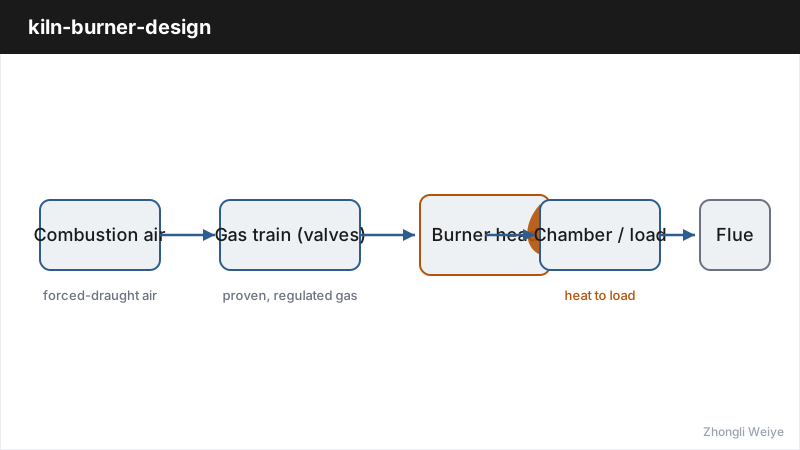
Distribution decides the outcome, not peak temperature
Peak temperature is the easy number. A burner of a given rating will deliver its rated heat, and a kiln will hold a setpoint all day. The harder question is what happens at the edges of the load, where air velocity drops and radiant contribution from the burner falls away. Those edges are where scorching appears, and on the same run they are where under-fired corners appear too. Raising the peak to compensate makes both worse rather than better, because the centre runs further ahead of the edges while the gradient stays the same.
Design effort therefore belongs on distribution: where burners sit relative to the ware, the spacing between them, and how recirculation moves air through the load rather than over it. Air that passes over a stack of ware heats the top surface and leaves the core behind, while air forced through the gaps between pieces reaches the core directly. That distinction is the whole argument for how a gas burner arrangement is laid out, and it is why a correctly sized burner firing in the right places beats a larger burner firing in the wrong ones. Loading pattern matters as much as burner position here, since the same layout behaves completely differently on a tightly packed load and a loosely stacked one.
Low fire is where distribution falls apart
Ceramic and glass kilns spend a large share of their cycle at reduced firing, and holding temperature near the bottom of the burner range is where unevenness is most likely. The reason is specific rather than general: as firing rate falls, the momentum that was driving recirculation through the load weakens, and the air pattern that carried heat to the load edges changes shape instead of simply shrinking in proportion. A layout that distributes well at full fire can quietly stop distributing at low fire.
This is why turndown and distribution have to be evaluated as one problem on kiln work. Kilns that hold their edges through a long soak are usually the ones where the burner selection accounted for low-fire behaviour rather than only rated output. The turndown-ratio guide covers how to find the band where combustion genuinely stays stable, and on a kiln that band has to coincide with the band where the air pattern still reaches the load edges.
Where low-NOx requirements sit in the trade
Permit limits on NOx have become a routine design input for kilns in many regions, and the requirement interacts with the rest of the design rather than sitting beside it. A staged burner is the usual answer, because it lets a high-flame mode run only where and when it is needed while temperature is otherwise held on a lower-NOx mode. Confirm which limit actually applies at your location before the layout is fixed, because the modes that matter differ between markets and fuel grades.
The trade is real and worth stating plainly. A burner and fitting arrangement chosen for clean combustion is often less forgiving at low fire than a simpler arrangement, because the staging that suppresses NOx also changes how the air is distributed when only the first stage is lit. Low-NOx capability and low-fire distribution therefore need evaluating together rather than one after the other. Where the two genuinely conflict, the emission limit is not negotiable, so the distribution has to be solved another way, usually through air-side tuning rather than burner selection.
Reliability means restart behaviour, not just uptime
Where kilns run continuously, reliability is a question about the burner and its accessories over years rather than over a commissioning week. It still rests on the combustion basics: correct air supply, clean and correctly sized components in the gas train, and a gas path that does not depend on a single fragile fitting. Flame detection and the flame detector arrangement matter more here than on a batch kiln because an unplanned purge and relight cycle disturbs a much larger amount of ware.
Shutdown and restart behaviour deserves specific attention on a continuous line. A kiln that has to be brought back to temperature after an upset carries a long recovery, and the burner arrangement that returns to temperature predictably is worth considerably more than one that reaches temperature faster during normal running. It is also worth being explicit about which failures the burner can actually address, because refractory condition and ware loading constrain the answer just as much as the burner does, and a burner asked to compensate for a worn lining will be judged as a failure.
What to specify before asking for a burner
Four things make a kiln burner discussion productive: the ware loading and how it is placed, the firing curve you need to hold including ramp and soak rates, the emission limit that applies, and the fuel with its available pressure range. With those in hand the conversation can be about distribution and turndown, which is where the design problem actually lives. Without them any proposal will be sized on rated output, and rated output was never the difficult part.
Adding the kiln dimensions and the number of burner positions available helps more than expected, since distribution questions are about spacing and the gaps between firing zones rather than about total heat. If you already run kilns and the real problem is edge scorching or inconsistent corners, describing where the defects appear on the ware tells us more about the air side than any temperature figure would, because the location maps directly onto the burner layout.
Frequently asked questions
What makes a kiln burner different from a general industrial burner? Two things: it has to hold distribution at low fire, and it has to survive continuous duty without pushing the product past its firing limit. A burner that delivers rated heat is not difficult to find, whereas one that keeps the edges of the load even through a long soak is a much narrower category.
Why does distribution matter more than peak temperature? Because peak temperature is what any controller of adequate rating can reach, while distribution is set by burner placement, spacing and recirculation. Scorching at the edges and under-fired corners are both distribution failures, and raising the peak widens the gap between centre and edge rather than closing it.
Do kilns need low-NOx burners? It depends on the limit that applies at your location and on your fuel. Where a limit exists, a staged or low-NOx burner arrangement is the usual way to meet it. Confirm the applicable limit before the layout is fixed and evaluate the low-NOx modes together with low-fire distribution, since staging changes air distribution at low fire.
How does turndown affect ware quality? Directly, because below a certain firing rate the recirculation pattern carrying heat to the load edges weakens and changes shape rather than simply fading. Kilns that hold their edges through a long soak usually have burner selection that accounted for low-fire behaviour rather than rated output alone.
What information is needed to size a kiln burner? Ware loading and placement, the firing curve including ramp and soak, the applicable emission limit, and the fuel with its pressure range. Adding the kiln dimensions and the number of available burner positions helps, since distribution is about spacing between firing zones rather than total heat.
How often does a kiln burner need service? The interval depends on fuel quality, dust in the combustion air and how often the kiln is cycled, so no single interval is honest. What is worth agreeing in advance is the gas train arrangement, because that determines whether a routine service keeps the burner running or turns into an unplanned shutdown.
Request a quote
Send the firing curve, the ware loading and the applicable emission limit, and we can look at distribution and turndown against a real cycle. If you already run kilns and the problem is edge scorching or inconsistent corners, describing the load arrangement and where the defects appear tells us more about the air side than a temperature figure would.
Related products
The burner families and gas train parts kiln work usually involves:
This guide covers Kiln Burner Design: Distribution Before Peak Temperature. For the exact part that fits your duty, send us the model plate photo and we confirm availability, lead time and a matched quotation.