
A maintenance routine earns its keep on the days nothing happens. The value is not in the inspection but in the record it leaves, because a burner measured on a schedule produces a trend, and a trend is the only early warning most failures give. Without the measurement, the first indication is usually a lockout.
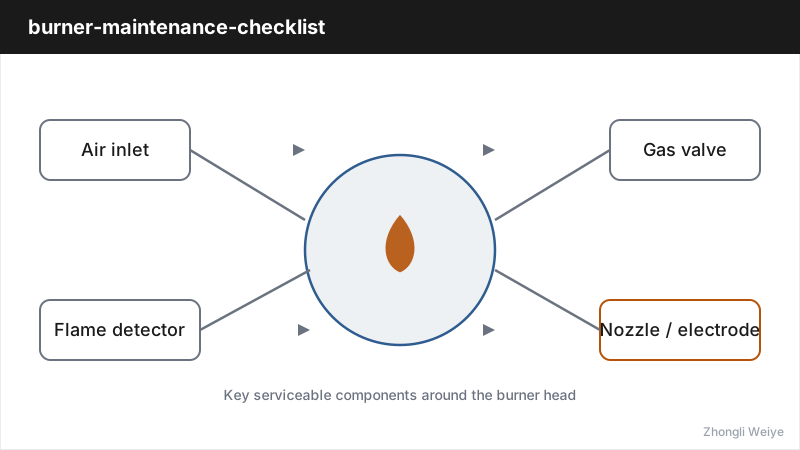
What a useful record actually contains
A tick in a box says the job was done. It does not say anything was found, and it cannot be compared with last time. A record carrying a measured value can. Reading the same quantity at each visit turns a sequence of unrelated observations into a series, and a series shows drift long before any single reading looks wrong.
This is the whole argument for writing numbers down. A flue gas reading, a gas pressure at the burner inlet, a flame signal strength, a pump delivery pressure: each means little alone and a great deal in sequence. The visit that records nothing useful has cost time and bought nothing.
Setting the interval from the duty
A burner firing continuously in a dusty atmosphere consumes filter elements, nozzles and electrodes faster than one on clean gas at steady load. An oil burner on heavy fuel needs fuel-side attention a gas burner will never need, and a burner near a corrosive atmosphere ages the electrical parts sooner than the calendar suggests.
Run hours are a better basis than elapsed months, because a burner that rarely fires should not accumulate the same wear as one running continuously. Where a burner is enabled and disabled frequently, calendar time still matters for parts that age rather than wear, such as seals and certain lubricants. The practical schedule combines the two, and it is worth recording which parts are on hours.
The fuel side carries most predictable failures
On an oil burner the sequence is well understood: strainer, pump, nozzle, and the filter in the line. A strainer that loads reduces pump suction and delivered pressure; a worn pump shows as a pressure that will not hold under load even though it reads correctly at rest; a carbonised nozzle changes the spray pattern, and a changed pattern shows as a sooty or unstable flame long before anything smokes.
The sequence is predictable because it runs in order. A burner oil pump is downstream of the strainer and upstream of the nozzle, so attending to the earlier item protects the later one. Skipping the strainer and replacing the pump achieves the same at a higher cost, and the new pump sits in the same loaded oil when the next failure comes.
Air path and actuator checks are easy to defer
The air side is inspected less often than the fuel side because nothing on it fails visibly. A damper that has slipped a degree, a linkage loosened at its fixing, and a filter loaded in the windbox all produce a gradual change in ratio rather than a fault, and the burner keeps running while the fuel bill rises.
Checking damper actuator travel against its commanded position turns an invisible drift into a number. The useful part is comparing it with the previous visit rather than a specification, because the question is whether it has moved.
Cleaning and proving are not the same activity
Cleaning removes what has accumulated. Proving establishes that something still works, and the distinction matters because the items most often skipped are the ones needing proof rather than cleaning. A flame detector lens cleaned is not the same as a flame signal confirmed afterwards, and a leak test timer observed is not the same as a leak test whose pressure decay was watched to completion.
Where a routine collapses into a visual walk-round, the proving tasks are what get lost, because nothing looks wrong when a safety device has been jumpered or a detector reads weakly. Putting them on the sheet as separate lines with their own result keeps them from being absorbed into the cleaning.
After any change, the burner is recommissioned
Maintenance disturbs things. A nozzle replaced, a head cleaned, an actuator linkage disturbed or a different fuel connected all change the conditions the burner was tuned for, and tuning correct before the work is not necessarily correct after it. A commissioning record is the reference that shows whether the work has shifted anything.
This is why combustion readings belong on the maintenance sheet rather than only in the commissioning file. The commissioning value is the baseline, and a reading taken six months later is only interpretable against it. Where no baseline exists, the first post-maintenance reading becomes the baseline, and the value starts from the following visit.
Frequently asked questions
What is the most commonly skipped burner maintenance item?
The flame detector sight path and the gas train leak test. Both are quick, neither is visible, and both are safety-critical, so they get dropped when a visit is short. They are also the two items whose failure shows as an unexplained lockout rather than a gradual loss of performance.
How often should an oil burner nozzle be changed?
On run hours and fuel condition rather than a fixed date. Heavier or dirtier fuel consumes nozzles faster, so a burner on clean light oil can go far longer between changes than one on heavier fuel. Carbon around the nozzle tip is the practical signal that the interval has run out.
Do gas burners need less maintenance than oil burners?
On the fuel side, considerably less, because there is no nozzle, pump or strainer to foul. Everything else, including the gas train, the shut-off valves, the actuators and the flame detector, needs the same disciplined attention. Cleaner fuel reduces the work rather than removing it.
Should a maintenance visit include a flue gas reading?
Yes, and it is the item that turns the rest of the record into a series. Oxygen, carbon monoxide and nitrogen oxide at each visit will show ratio drift, fouling and combustion problems developing, and they are the only measurements on the sheet that can be compared against commissioning.
What should be recorded after a maintenance visit?
The measured values rather than the actions, and what was found rather than only what was replaced. A note recording that carbon monoxide had risen over three visits is what allows a nozzle to be caught before it fails, and it is the part of the record no one reconstructs afterwards.
How do I decide whether my maintenance interval is right?
By looking at what the record shows. If the same item needs attention every visit, the interval is too long for the duty. If an item has never been touched in two years, the interval may be generous for a burner that rarely runs.
Request a quote
Send the burner model, the fuel, and roughly how many hours a year it runs, and we can indicate which parts are worth holding as spares and on what interval. If you already keep a maintenance record, the last few flue gas readings and pressure values usually show where the burner stands.
Related products
The parts and product families referenced in this guide:
- checking delivery pressure under load
- recording travel against the last visit
- the baseline every reading is compared against
- strainer, union and electrode consumables
This guide covers Burner Maintenance Checklist: The Items That Prevent Downtime. For the exact part that fits your duty, send us the model plate photo and we confirm availability, lead time and a matched quotation.