
Commissioning is the one window in a burner's life when every mechanical, electrical and combustion fault is still cheap to correct. A month later the same defect hides behind a settled control loop and a production schedule that will not tolerate a shutdown. A commissioning checklist matters not for the tests it lists, but because it forces someone to decide in writing what has actually been proven.
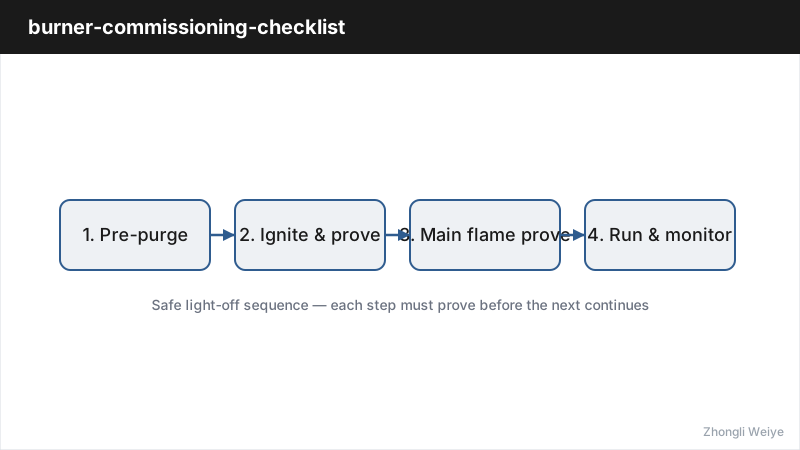
01
The safety chain gets proven cold
Every interlock is tested with the burner not firing, and each is tested by forcing the condition it exists to detect rather than by assuming the wiring was followed. Air pressure proved low, gas pressure proved low, a pressure switch opened by hand. High gas pressure proved. The proving valve operated through its full stroke. The flame detector blocked, and the burner refused to fire.
Two failures repeat often enough to name. A valve proving system bypassed with a link during an earlier fault and never restored means the burner has run for months with no proof that the shut-off valves seat. The second is an interlock that does fail correctly but has never been checked in automatic mode, so the fault would clear on the next start.
02
Purge times are measured, not assumed
Before light-off the appliance is purged for the volume its manufacturer specifies, with dampers proved in the purge position and the air path confirmed open. The relevant question is how long since the last firing, and what volume the chamber holds once the door and inspection openings are accounted for. A chamber with a viewing port open on the far side purges more slowly than the arithmetic suggests.
The reverse error costs an hour of production and confuses flame detection on the next start. A purge timer left running while a technician is called away leaves a hot chamber behind it. Commission the timer as a real interlock with a proven termination condition, so an aborted purge cannot be mistaken for a completed one.
03
Combustion is verified across the range
After light-off, let the burner stabilise before reading anything, then walk from high fire to the lowest fire the appliance will hold. The point of the walk is the difference between steps, not any single value. An appliance clean at high fire that produces carbon monoxide at low fire has an actuator or linkage fault, and which of the two moved first usually identifies it.
Record the servo travel at each end of the range during the same walk, because those numbers are the baseline every later complaint is compared against. A modulating appliance with a documented low-fire position can be diagnosed by phone six months later. One without it needs a site visit. The walk also establishes the turndown actually achieved, as distinct from the brochure figure.
04
What the handover document has to contain
The handover pack is the deliverable, written on the day rather than reconstructed later. It needs the serial numbers of the burner, the program controller and the gas train components as installed, the nozzle type and rating where liquid fuel is involved, the flue gas readings at each step, and the damper and fuel valve positions at both ends of the range.
It also needs the parts list with supplier codes, because a parts cross-reference done at handover is the difference between a phone call and a guess eighteen months later. Anything outstanding is written down as outstanding, with a date and a name against it. A sheet with no exceptions column acquires exceptions quietly in month two, and the record then describes an appliance nobody has seen.
05
What invalidates the sign-off
Any change to the fuel path, air path, control platform or detection method puts a previous sign-off out of date. So does a change in who holds responsibility for the plant, because the sign-off transfers knowledge and that does not transfer automatically. Where a new solenoid valve is fitted, the proving cycle and leak test are repeated.
The gap that causes most trouble is seasonal. A commissioning carried out in mild weather proves little about the air path in winter, because the ratio on a fixed air inlet moves with ambient density. Where that applies, the honest answer is a second seasonal check, and the flue gas analysis notes cover what to record so the readings can be compared.
06
Frequently asked questions
How long does burner commissioning normally take?
For a single-stage appliance with its gas train installed, a cold check plus purge plus range walk is a working day. Liquid fuel adds time, because the oil circuit is filled, bled and proved separately from the gas work. Time spent proving interlocks cold is repaid; rushing them returns as a fault call.
Who should carry out the commissioning?
Someone who did not install the appliance. The installer knows what they intended; the commissioning engineer sees what was actually done, and the difference between those two is where the faults live. An independent pair of eyes on the interlock chain is the cheapest insurance in the programme.
Do I need to recommission after replacing one component?
Not fully, but the checks that component could have affected. A new shut-off valve means the proving cycle and leak test are repeated. A new flame detector means detection is proved cold and then on a real flame, because a detector that works on the test circuit can still fail to see the actual flame shape. A new air damper actuator means the ratio walk is repeated end to end.
What commissioning records matter for emissions obligations?
Keep the readings, the instrument identity and its calibration date, the sampling position, and the date. Obligations are assessed against the limits applying where the appliance runs, and confirming them means measurements taken and reported the way those requirements expect. Ask for the applicable limits in writing before the visit so measurements can be planned rather than repeated.
Can commissioning happen with the plant already in production?
Mechanically yes, and done that way it usually is not done properly. Work around a live process tends to accept readings taken before the appliance settled, and to skip cold interlock tests because the gas train is live. Where production cannot stop, split the work: cold proofing during a planned outage, ratio verification at the next process window, both recorded separately.
What is the most commonly missed commissioning step?
Restoring whatever was bypassed during installation. A closed valve left open, a temporary link left in the interlock, an earth strap removed for a delivery note. None of these show as a fault on the day, and all of them become one later. The handover document is where they surface, which is the practical argument for writing it on the day.
07
Request a quote
Zhongli Weiye supplies burner control platforms, gas train components and replacement parts matched to the appliance installed, plus the spares list a site needs to close out a commissioning properly. Send the burner model, the control platform and the stage your commissioning has reached, and the recommendation comes back with the parts that fit and anything worth checking before the visit.
08
Related products
The parts and product families referenced in this guide:
- burner commissioning worksheet
- controller handover settings record
- valve proving before first light
- interlock chain cold proving
- flame detector proving on site
This guide covers Burner Commissioning Checklist: Sign-Off That Sticks. For the exact part that fits your duty, send us the model plate photo and we confirm availability, lead time and a matched quotation.