
Almost every burner component is defined by a standard interface rather than by the maker's name. Pipe threads, pressure classes, electrical ratings and detection principles are shared across brands, so the part that fits is usually identifiable from a photograph and a few measurements. What makes a cross-reference reliable is working from those functional values rather than from the label.
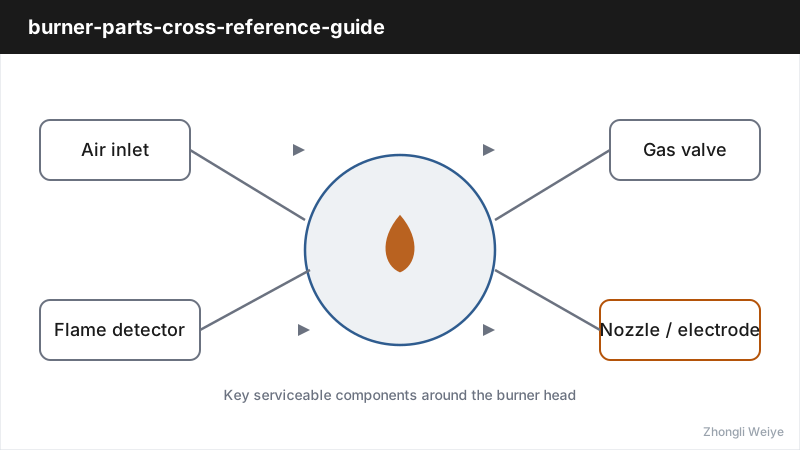
Three photographs settle most questions
Before anything is ordered, take a photograph of the part label, of the burner nameplate and of the fitting position with its neighbours in frame. The label gives the supplier's code, the nameplate the appliance family, and the position establishes the function, which decides the match when the code alone is ambiguous. Asking for these three images first converts most back-and-forth into one confirmation.
The fitting position matters more than people expect. A solenoid valve in a gas train between the regulator and the manifold does something different from an identical-looking valve fitted as an oil cutoff on a pump outlet, and the coil arrangement will not be the same. A photograph of the pipework resolves in seconds what a verbal description cannot.
Match on function, then on the numbers that matter
Each family has its own deciding values, and a cross-reference that ignores them is a guess. Valves are matched on coil voltage and frequency, pipe size, pressure class and suitability for the gas in use. A flame detector is matched on detection method, the fuel it can see and its approval. A program controller is matched on detection method, the stages it sequences and the wiring base it expects.
Pressure switches add a setting range and a differential, and those are where most mismatches occur, because two switches from different families share a housing size and differ entirely in the range they cover. A transformer is matched on output voltage, current and connection type. In each case the deciding values are published, and the part number labels them rather than being the thing itself.
Where a substitute is reasonable and where it is not
A substitute is reasonable when the interface and functional values match and the failure mode is not safety-critical in a way the original addressed specifically. A pressure switch whose range and differential match replaces one that has dried out. A servo motor with the same torque, speed and mounting often replaces a failed one, provided the control signal and travel feedback are compatible.
Substitution is a different matter on the safety chain. The two shut-off valves in a gas train, the proving device and the flame detector have failure modes with consequences the other components do not, and the reason a part was specified is often a property absent from a catalogue listing. Where the original is unavailable, confirm equivalence against the appliance documentation rather than assuming the nearest-looking part does the same job.
Reading a part number as a code, not a name
Supplier codes are structured, and the structure is usually the same between related parts in one family. The letters often carry the family, the digits the size or variant, and a trailing letter distinguishes a regional revision. Reading the code as a phrase rather than an identifier produces the mis-order: a metric-thread part and one for the same nominal size in inches often share most of the string.
Where the code has been lost, measure rather than guess. Thread form and size, overall length including the mounting face, the position of the electrical entry relative to the body, and the stroke or setting range of anything adjustable. Those values plus the function identify most components well enough to shortlist, and the shortlist is where a supplier's cross-reference becomes useful rather than guesswork.
A record that survives staff changes
A code book only pays for itself if it is still there and current when the next failure happens. It should live with the appliance rather than in someone's inbox, record enough to reorder without a site visit, and note what was tried and rejected so the next person does not repeat the experiment.
Frequently asked questions
Is an equivalent burner part as good as the original?
Where the functional values and interface match, an equivalent performs the same job. The question is whether the part was specified for a reason a catalogue listing does not show. On a pressure switch, a range and differential match is usually sufficient. On the safety chain, where the failure mode has consequences for the installation, confirm equivalence against the appliance documentation rather than inferring it from a listing.
How do I identify a burner part with no legible part number?
Measure rather than guess. Record the thread form and size, the length, the position of any electrical entry relative to the body, and the range of anything adjustable. Add the function the part performs and the fuel or media it carries. That set narrows the field to a shortlist the supplier can confirm, and it beats reading a code off a worn or painted label.
Why does the same-looking valve not fit the gas train?
Because the housing is often shared across a family of duties while the internal set is not. A valve for a gas manifold and one for an oil circuit can share a body and differ in seat material and closure timing. Add the pressure class and whether the valve has a manual override, and the near-miss becomes an easy distinction. Photographing the position in the pipework settles the duty.
Should spare parts be bought as a set or individually?
As a set where they work together and fail together, such as a gas train where the proving cycle depends on valve behaviour, or seals at a joint. Individually where the duty cycles differ, so replacing everything at once wastes parts with life left in them. A holding organised by function beats one organised by brand.
What information makes an order accurate first time?
Three photographs and four facts: the burner model from the nameplate, the control platform in use, the part function and position, and the application including the fuel. That resolves most orders. Anything beyond it, such as a specific approval requirement for the site, is worth stating explicitly, because it is the item most likely to send a correct part back.
How do I verify a substitute part once it arrives?
Check the physical interface first: threads, mounting, electrical entry and travel. Then check the functional values against what the position requires, and prove the function on the appliance. A replacement pressure switch is proved by forcing the condition it detects; a flame detector is proved on a real flame, not only its test circuit. The commissioning checklist notes cover which checks each change calls for.
Request a quote
Zhongli Weiye supplies burner components across the gas train, the oil circuit, the control platform and the air path, and matches a replacement to the appliance and the function recorded for it. Send the burner model, the control platform and photographs of the part and its position, and the recommendation comes back with the parts that fit, including any equivalent worth considering.
Related products
The parts and product families referenced in this guide:
- burner spares holding list
- fitting replacement sequence
- controller family cross reference
- detector specification matching
- coil voltage and pipe size matching
This guide covers Burner Parts Cross-Reference: Matching Spares to the Machine. For the exact part that fits your duty, send us the model plate photo and we confirm availability, lead time and a matched quotation.