
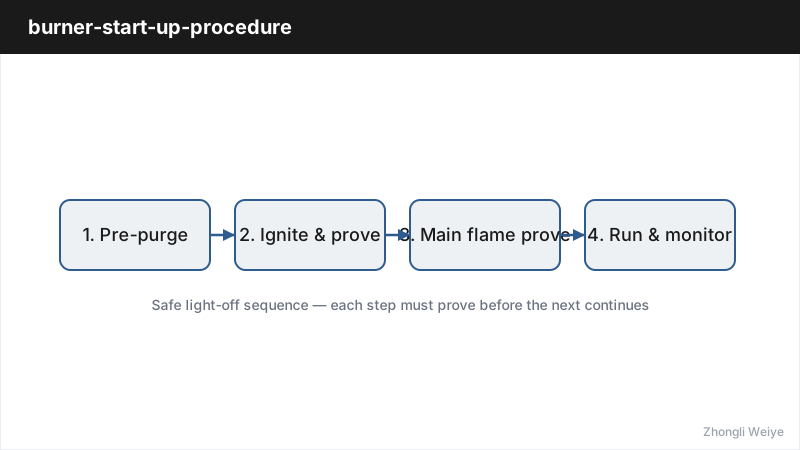
A burner start-up is a fixed sequence because every step proves the one before it. The order is not a convention and it is not a matter of local practice: each stage exists to make sure the condition it depends on is true, and removing one breaks the argument for the next. Most light-off incidents trace back to a step that was shortened rather than to equipment that was wrong.
What has to be true before the sequence starts
The pre-checks are the part most likely to be skipped, because nothing happens during them and the burner is standing still. Combustion air has to be available at the burner, because a burner cannot light without air and will lock out with a fault that looks like an ignition problem. The gas train has to be proved, the flame detector healthy and the interlocks closed. And the chamber has to be in a condition where purging will actually clear it.
Checking that the burner is not already in lockout matters more than it sounds. A burner that resets and appears to be ready is still holding the reason for the previous lockout internally, and restarting it into the same condition produces the same lockout. Reading the fault before resetting is what turns a repeated failure into a diagnosis. The troubleshooting guide covers how faults are read once they are there.
Why the purge length is what it is
The pre-purge exists to displace any unburned gas in the chamber, the flue and the burner itself, and to establish airflow through the appliance. Its duration is derived from the volume that has to be cleared and the air flow available, which is why a burner moved to a different duct or a different chamber needs the purge recalculated rather than copied.
Skipping or shortening it is the single change that converts a routine start into an incident. The burner has gas at the nozzle and an ignition source present, so the chamber atmosphere decides what happens. The safety interlock guide covers the reasoning behind the step, and a purge that is set once and never revisited after a duct change is a common finding on an older installation.
Ignition and the proving window
Ignition energises the ignition transformer, the valve opens, and the burner has to establish a stable flame inside a defined window. If the detector does not confirm flame within that window, the controller closes the valves, purges again and either locks out or retries depending on configuration. The window is short because it is bounded by the time gas can accumulate.
The detector has to see the flame that actually forms, which is why the position of a UV flame detector or an ionisation detector is set by where the flame goes rather than by convenience. A detector that cannot see the flame produces a burner that will not light, and one that sees a flame that later lifts produces a burner that lights and then locks out. Where ignition fails, transformer and electrode condition is worth checking before anything else, because it is the part that ages without visible warning.
Lockout means the condition still exists
A lockout is a report, not a fault. The controller has detected something it considers unsafe and it has shut down, which means the cause has not been removed by the reset. Where a burner locks out repeatedly, the fault history says more than the reset does, because the pattern distinguishes an ignition failure from a flame that lifts after light-off, and those lead to entirely different investigations.
Retrying indefinitely is not a remedy. It relights the burner into a condition already known to be unsafe, and each attempt puts an ignition source into a chamber that has just been purged. Where the fault is genuine, the correct response is to find it. The commissioning checklist covers first light-off in more detail than a routine start does.
Confirming the run before handing over
Light-off is not the end of the sequence. Stable flame has to be confirmed at each zone, gas and air pressures have to read where they should, and the flue has to be examined for a clean result. Anything adjusted during commissioning has to be recorded, because an unrecorded adjustment is something the next person will undo.
Automatic control should only be enabled once the manual condition has been verified, which is the step that separates a commissioning start from a running burner. Where a programme controller is being used, the ramp and soak behaviour is part of what is being commissioned, not something to be discovered on the first production cycle. Universal controllers carry the same sequence, so the proving requirements apply equally to either type.
Frequently asked questions
Why must a burner be purged before ignition?
To displace any unburned gas from the chamber, flue and burner so the atmosphere cannot support a flame. The burner has gas at the nozzle and an ignition source present, so the chamber atmosphere decides the outcome. Purge duration follows from chamber volume and air flow, so it has to be recalculated if either changes.
What does it mean if a burner will not light?
The controller did not see a stable flame inside the proving window, so it closed the valves and either retried or locked out. Causes include no combustion air, a failed ignition transformer, an electrode at the wrong gap, a detector that cannot see the flame, or a gas train that is not proving.
Why should a lockout fault be read before resetting?
Because resetting does not remove the cause, so the same condition produces the same lockout. The fault history also distinguishes an ignition failure from a flame that lifts after light-off, and those two lead to completely different investigations.
Is it safe to keep a burner in automatic mode after starting it?
Yes, but only after the manual condition has been verified. Stable flame at each zone, correct gas and air pressures and a clean flue should all be confirmed before automatic control is enabled, and any adjustment made during commissioning recorded.
What should be checked before starting a burner?
Combustion air available at the burner, the gas train proved, the flame detector healthy, interlocks closed, and the burner not already in lockout from a previous fault. A burner that has been modified, with a new duct or chamber, also needs its purge recalculated.
How often should start-up verification be repeated?
Full verification is a commissioning activity rather than a daily one. What should be routine is reading the fault history and confirming the burner did not lock out overnight, since a burner that re-locked while unattended has a fault that needs finding rather than a start button that needs pressing.
Request a quote
Send the burner model, the controller type and the chamber arrangement, and we can confirm the sequence and timing requirements for the installation. If you are commissioning a burner that has been standing or rebuilt, the modification list is the most useful part of the enquiry, because that is what determines whether the existing purge and proving settings still apply.
Related products
The parts and product families referenced in this guide:
- light-off sequence controller
- universal burner controller
- UV flame detector
- ignition transformer
- gas leak detector
This guide covers Burner Start-Up Procedure: The Safe Light-Off Sequence. For the exact part that fits your duty, send us the model plate photo and we confirm availability, lead time and a matched quotation.