
Almost every burner fault that recurs has been seen before by somebody. The reason it stays difficult is that the symptom is rarely the fault itself: a lockout at ignition might be a failed detector, a marginal air switch, or a gas train left open after maintenance, and all three look identical from the front of the panel.
Read the fault before touching anything
The first diagnostic step is free and is skipped more than any other. Most controllers record which proof failed or which step timed out, and that fact narrows the field to one subsystem before a screw is undone. A burner that locks out during flame proving and one that locks out on a gas pressure switch are different faults producing the same silence on the plant.
Where a controller has no memory, the operator's description is the equivalent. A burner that will not start and a burner that starts then shuts down are different faults. Writing down what the burner was doing, what it was asked to do, and what happened instead takes a minute and separates a systematic search from a guessing loop.
Separate the fault into one of four areas
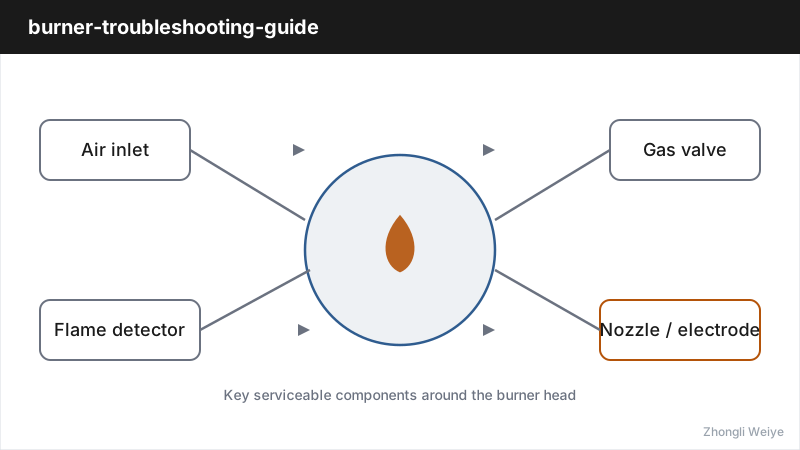
Every burner fault belongs to one of four areas, and the discipline is to place it before investigating. Fuel supply covers the train, the strainer, the valves and the pressure. Air side covers the blower, the dampers and the air path. Ignition covers the transformer, the electrode and the gap. Detection covers the detector, its siting and its wiring.
Grouping matters because each area has its own short list of causes and a quick measurement that settles it. A gas-side fault is settled by pressures during a start. A detection fault by signal strength. An air fault by pressure in the plenum. An ignition fault by looking for a spark, which takes two seconds and eliminates a whole area.
Two-minute tests that eliminate most areas
Watching a start with the gas pressure gauge in place settles the fuel area faster than anything else. If pressure at the valve is present and steady through the attempt, the train is working and the fault is not there. If it collapses when the valve opens, the strainer, the regulator or the valve is the candidate, and where it collapses tells you which.
Watching the detector signal through a start establishes a great deal. A strong signal says ignition worked and the detector sees the flame, which moves the fault elsewhere. No signal with visible flame points at the detector, its siting or its wiring rather than at combustion. On an oil burner the same observation also says whether the fuel pump and nozzle are delivering, since a rich spray obscures the flame rather than sitting in front of it.
Sooty flame and lifting flame are opposites
A sooty, lazy flame means too much fuel relative to air: a restricted air path, a clogged nozzle, a leaking valve, or a chamber under negative pressure. A lifting, unstable flame means the opposite: too much air, too little fuel pressure, or a draught strong enough to disturb the flame shape. Treating these as one symptom sends the investigation the wrong way.
A flue gas reading settles which side you are on before anything is removed, because low oxygen with high carbon monoxide points somewhere quite different from low oxygen with a lifting flame. Measuring first also gives the tuning after a repair a reference to return to.
Intermittent faults need a record, not more patience
An intermittent fault defeats any inspection done in a single visit, because the burner behaves correctly while you are watching. What works is a written log: date, load, what was happening, what was displayed, what was measured. These faults correlate with conditions, and a log reveals that it always happens at low load, or only after the burner has been off a while, or only on a cold morning.
The temptation is to change the part that seems most likely. This is where logs earn their keep, because a fault that never appears in the log but keeps recurring is usually a marginal condition rather than a failed component, and a marginal condition responds to a setting rather than a new part.
When the fault is not on the burner
Some recurring faults originate outside the burner. A re-bricked chamber, an altered duct, a fresh coating inside a chamber, or a process that now holds a different pressure all change the conditions the burner was set up for. The symptom appears on the burner because that is where it becomes visible.
Asking what has changed on the appliance since the burner last ran correctly costs nothing and explains a large share of faults no burner work will resolve. The parts on the burner are usually the last thing to have changed, and the first thing anyone replaces. Where the appliance has been altered, a cross-reference of parts that differ between families saves a second strip-down.
Frequently asked questions
Where should I start when a burner will not start?
At the controller's fault record, then at the gas pressure during a start attempt. Those two observations place the fault in the fuel area or rule it out, which is usually more than a full strip-down achieves.
Why does my burner start and then shut down?
Because it lit and then lost a condition. Flame that proves briefly and dies points at detection, air, or fuel pressure reaching the head. Flame that relights repeatedly points at the same causes plus a marginal proof in the run circuit.
What causes lockouts at the same time of day?
Conditions that vary with the time of day: supply pressure that dips predictably, a chamber that cools overnight and draws differently, or a controller reaching the bottom of its turndown. All worth checking before a component is replaced.
Should I replace the flame detector first when a burner will not hold a flame?
Rarely. The detector is one of four possible areas, and replacing it on a burner whose real fault is an air switch changes nothing while costing a part and the access time to fit it. Read the signal during a start first.
How do I know whether a fault is a setting or a failed part?
Settings produce faults that are consistent at a particular condition and respond to adjustment. Failed parts produce faults that ignore condition and do not respond to adjustment. If adjusting the relevant setting changes nothing, a failed part is likelier.
Should I keep a log even after the fault is fixed?
Yes, because a repair without a record cannot be evaluated later. The note saying what was measured before and after lets the next person tell a fixed fault from one that has gone quiet.
Request a quote
Send the burner model, the fuel, and what the controller displayed at the moment of the fault, and we can often narrow the likely area before quoting. For a recurring fault, the load condition and whether it happens on start or during run change the answer most.
Related products
The parts and product families referenced in this guide:
- pump and nozzle delivery on an oil burner
- oxygen and CO as a first split
- proving the pilot before blaming the train
- checking whether a part still exists
This guide covers Burner Troubleshooting Guide: From Lockout to Root Cause. For the exact part that fits your duty, send us the model plate photo and we confirm availability, lead time and a matched quotation.