
A pilot is a small flame with a narrow job: it exists at the moment the main flame does not, and its purpose is to give the ignition source something to ignite and the detector something to see. Understanding why it works, and why so many modern burners no longer have one, comes down to how a small flame behaves in a stream of combustion products.
Why a small flame is harder to keep lit
A pilot flame has a low fuel flow, which means a low flame velocity, which means the combustion products rise past it slowly. Those products are hot and they contain oxygen, and that combination is what extinguishes a small flame. The same products rising past a large flame are diluted by the flame's own output before they reach the front of it.
This is why pilot design is dominated by aeration and by where the flame sits relative to the gas stream. A pilot fed with enough primary air produces a small, hot, fast flame that resists being carried away. One fed with too little air produces a lazy flame that sits in its own products and gutters out. The window between them is narrow, and it moves with gas pressure and with draught conditions at the burner.
The orifice is the part that decides
Pilot output is set by the orifice, and an orifice that is even slightly restricted changes the mixture rather than just the size of the flame. Less gas through a fixed aeration setting means relatively more air, which moves the pilot toward a leaner, lazier flame. The result lights but produces a weak signal, a fault that looks like a detector problem and is not.
Carbon and debris in the orifice produce the same symptom. This is why pilot maintenance is mostly a cleaning operation, and why a pilot that has locked out repeatedly is worth cleaning before any part is replaced. Scale inside the orifice is invisible from outside and shows as a pilot that will not hold a strong, steady flame.
Where the pilot sits is a design decision
A pilot flame has to be in the gas stream, or the main gas will not reach it. It also has to be where the detector can see it and where the main flame will sweep across it when it opens. These requirements compete, and the resolution is a specific geometry: the pilot sits at the edge of the main gas stream, angled so the main flame rolls over it, and close enough to the electrode to ignite reliably.
Where draught through the burner is strong, that geometry becomes the difference between a pilot that lights every time and one that lights on a still day. The air side arrangement of the burner sets the draught the pilot has to survive, which is why a pilot fault sometimes appears only after a fan or damper change elsewhere.
Interpilot and purge between pilot and main
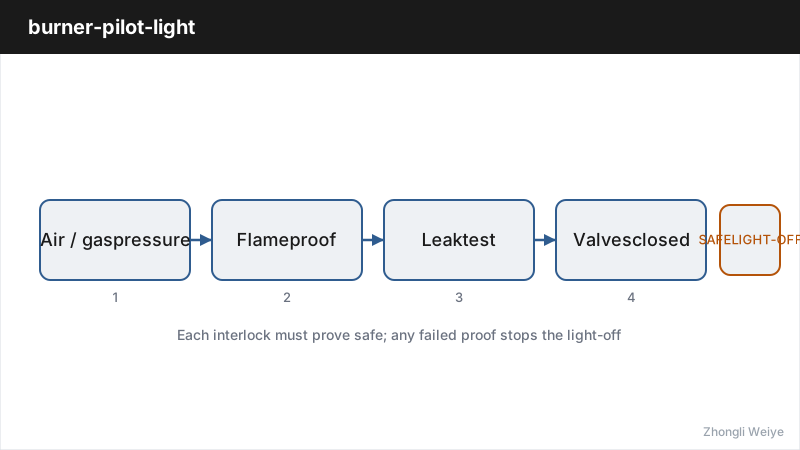
The period between proving the pilot and opening the main fuel valve is where the design either prevents an ignition accident or does not. An interpilot period holds the pilot burning with the main valve shut, allowing the main gas path to be swept of air. The alternative, and this is easy to get wrong, is to admit main gas into a chamber that still contains pilot products and no air. A solenoid valve closing quickly is what makes that alternative survivable when it happens.
This is why the pilot arrangement and the purge logic are one design rather than two. A burner with a proved pilot still needs the chamber in a known state when main fuel opens, and a standing pilot burning for hours is continuously changing what is in the chamber around it.
Why direct ignition displaced the pilot
On a modern burner the main gas can be ignited directly. The electrode sits in the gas stream with a gap the spark can jump, the main valve opens, the spark fires, and the main flame establishes. There is no small flame at all, which removes the pilot along with its orifice, its aeration adjustment and its own failure modes. The ignition transformer and electrode arrangement becomes the whole ignition system.
What direct ignition costs is the light-off window. The main flame has to establish within the ignition period from a spark present for a fraction of a second, and if it does not, the sequence fails. A proved pilot extends that window because the pilot flame is already there when the main gas arrives. Some burners therefore carry both arrangements, using direct ignition as standard and a pilot where the duty needs a longer light-off.
Frequently asked questions
What is the difference between a standing and an intermittent pilot?
A standing pilot burns continuously from shutdown to shutdown. An intermittent pilot is lit only for the start sequence, proved, then extinguished once the main flame is established. Intermittent saves fuel and is the norm on modern burners, but it needs a fast, reliable ignition to work at all.
Why does my burner lock out at pilot prove when the pilot is clearly lit?
A visible flame and a detectable flame are not the same thing. The detector may be mis-sited, the pilot may be too far from it, or the pilot flame may be too weak to produce a signal even though it is burning. A signal reading during the prove tells you which.
Can a standing pilot be left off to save fuel?
Only if the burner design supports it. Where the sequence expects a proven pilot before main fuel opens, extinguishing it removes the proof the controller is waiting for. A standing pilot is a continuous ignition source and belongs to the burner, not to the accessories.
What causes a pilot flame to be weak or lazy?
Usually a restricted orifice, which starves the flame and pushes it toward a lazy burn, or insufficient aeration at the pilot. Low gas pressure does something similar. All three make the pilot harder for the detector to see, so the fault presents as detection.
Is a pilot flame necessary on a modern burner?
On many burners it is not, because the main gas is ignited directly and no separate flame is needed. It remains useful where a longer light-off window is required or the process needs an ignition source that persists. The burner design decides which arrangement is available.
How often should a pilot be cleaned?
On the same schedule as the rest of the ignition system, and whenever a pilot prove failure recurs. Cleaning the orifice and checking the aeration takes minutes and is the first thing to do, because a weak pilot produces the same symptom as a failed detector.
Request a quote
Send the burner model and whether it uses a standing pilot, an intermittent pilot or direct ignition, and we can identify the parts involved and what is likely worn. For a pilot that will not prove, a photo of the assembly and the gas pressure at the pilot usually settles the question.
Related products
The parts and product families referenced in this guide:
- spark source for direct light-off
- pilot gas shut-off solenoid
- detecting a small flame reliably
- draught conditions the pilot must survive
This guide covers Burner Pilot Light: The Small Flame That Enables the Big One. For the exact part that fits your duty, send us the model plate photo and we confirm availability, lead time and a matched quotation.