
A flue gas analyser converts burner tuning from an opinion into a record. It measures the combustion products that actually leave the stack, which is the only place where the air and fuel the burner was set to deliver can be checked against what the appliance received.
What the analyser is really reporting
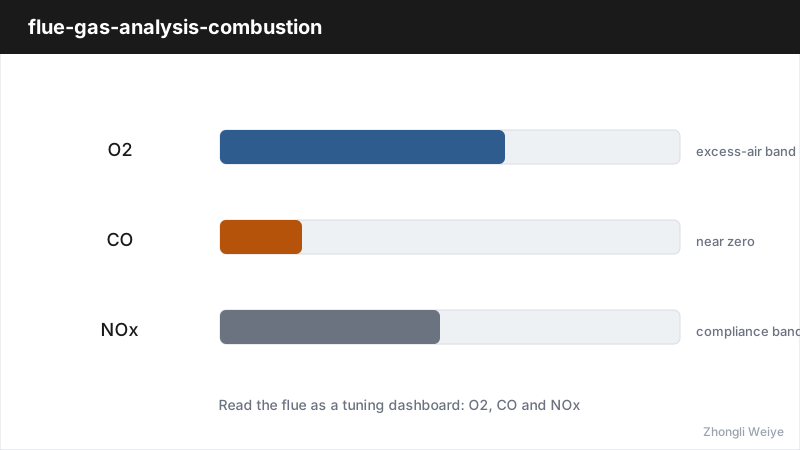
Oxygen in the flue is the excess-air proxy: air that was not consumed by combustion leaves with the products. Carbon dioxide confirms that fuel is burning at the level the burner was asked to reach. Carbon monoxide is unburned fuel, so any measurable value means the mixture is richer in part of the chamber than the setpoint implies. Where fitted for it, oxides of nitrogen extend the picture to emission behaviour.
The pairing carries the useful information. Oxygen and carbon dioxide together fix the air and fuel ratio the burner actually delivered, independent of any figure the programmer shows on the panel. A reading that looks unremarkable alone becomes meaningful once the same measurement is taken at another firing rate, which is why a proper survey is a ladder of readings rather than a single point.
Where the probe belongs
The measurement can only be as good as the gas that reached the instrument. A probe held inside the flame cone reads a local condition rather than the flue, and the number it produces will confidently send a tuner the wrong way. The correct position is in the fully mixed stream downstream of the combustion chamber, before any point where ambient air can dilute the gas. Where heat recovery sits between burner and stack, the sample belongs downstream of that device.
A different location is needed when the appliance fires into a duct. A duct wall behaves as a large cooled surface, and a probe immediately downstream can still sit close enough to the flame to read a local mixture. If two positions disagree persistently the difference is diagnostic: it usually means an unbalanced flow field, and a combustion air blower assessment is the next step.
Ratio drifts as the burner moves down its range
A single reading at high fire proves very little. The air and fuel actuators on a modulating burner are mechanical linkages, and they do not necessarily hold the same relationship to each other at the bottom of travel as at the top. Where carbon monoxide appears only at low fire, the usual causes are an air actuator that has lost stroke, a fuel valve that does not close fully, or a linkage loosened at one end of its travel.
The same ladder shows how much the air path influences the result. A burner drawing through a restricted inlet, or a filter loaded with dust, moves its ratio as air density changes with ambient conditions. An installation with a combustion air pressure switch at least annunciates a serious blockage; without one the only symptom is a slow seasonal drift, and reading that drift correctly matters more than any absolute number.
What the calculated efficiency figure is worth
Efficiency and stack loss are calculated from the measured quantities, and both inherit the accuracy of the flue temperature measurement. A probe that is not properly seated produces a temperature representing nothing in particular. The calculated figure stays useful as a comparison between commissioning day and a later inspection, and for spotting gradual degradation, provided the measurement position has not moved between visits.
Keeping the instrument worth trusting
Flue gas analysers fail in predictable ways. Condensate in the sample line collects at the lowest point and eventually destroys the oxygen cell. A filter left in service blinds the optical path and produces slow drift rather than clear failure. Sensors age even when the instrument sits idle, so a unit used for a year without a span check reports a confident and incorrect number.
Records matter as much as the instrument. Logging oxygen, carbon monoxide, flue temperature and firing rate at every visit makes a slow movement visible before an operator reports a symptom, and settles whether a repair worked. Where readings support an emissions record, the instrument identity, its calibration date and the sampling position belong in the same document.
Frequently asked questions
Which flue gas readings are worth taking on a routine survey?
Oxygen, carbon monoxide and flue temperature cover most of what a periodic check needs, and carbon dioxide makes the calculated efficiency figure meaningful. Oxides of nitrogen matter when an emissions record is required. Readings at more than one firing rate are worth far more than one set at high fire, because ratio problems appear at the low end first.
Why does carbon monoxide often appear only at low fire?
Air and fuel actuators are mechanical linkages, and the relationship between them can drift at one end of travel. An air actuator that no longer completes its stroke delivers less air at low fire than the fuel valve delivers fuel. A valve with a worn seat may not close completely, and a linkage loosened at the damper end changes the curve further down.
How far downstream should the probe sit from the burner?
Far enough that the flame is complete and the gas fully mixed, and before any point where outside air enters the stream. In a chamber application that normally means the flue just beyond the chamber outlet. In a duct application the sample often has to go further in or into the vertical section, because duct walls create cooled surfaces that disturb the flow.
Does a calculated combustion efficiency figure prove compliance?
No. It is an indirect calculation dependent on the accuracy of the temperature, oxygen and carbon dioxide measurements and on the sampling position staying put. Emissions obligations are assessed against the limits applicable where the appliance operates, and confirming that requires measurements taken and reported the way those requirements expect. Ask for the applicable limits in writing before commissioning.
Why do readings drift between summer and winter?
Air density changes with ambient temperature, and an open combustion air path delivers a different mass of air for the same fan or draught setting. A burner that holds its ratio across the seasons has a controlled inlet, as found on a gas burner built for continuous duty. A burner that drifts seasonally is reporting something real about its air path, and the remedy is mechanical.
How often should an instrument be calibrated?
Set the interval from how much the readings are relied upon rather than the calendar alone. A portable analyser used weekly for tuning needs a span check against known gas at frequent intervals. A unit kept for occasional inspections can follow a longer cycle, provided the sample line and filter remain serviceable.
Request a quote
Zhongli Weiye supplies the analysers, probes and burner hardware that support this kind of survey, and matches replacement parts to the burner and control platform already installed. Send the burner model, the control platform and the readings from your last survey, and the recommendation comes back with the specific parts that fit, plus anything worth checking on site before the next visit.
Related products
The parts and product families referenced in this guide:
- combustion air proving switch
- air supply tuning for a clean flue reading
- gas fired plant load matching
- stack temperature trending
This guide covers Flue Gas Analysis: Reading O2, CO and NOx Like a Tune-Up. For the exact part that fits your duty, send us the model plate photo and we confirm availability, lead time and a matched quotation.