
Boiler efficiency is a number with a definition attached, and the definition matters more than the figure. The efficiency that appears on a burner datasheet describes the appliance at one condition, usually full fire, measured to a standard. The efficiency that decides your fuel bill is a seasonal figure for the whole plant, including the hours the burner spends below its best point. The gap between those two numbers is where most of the recoverable loss sits.
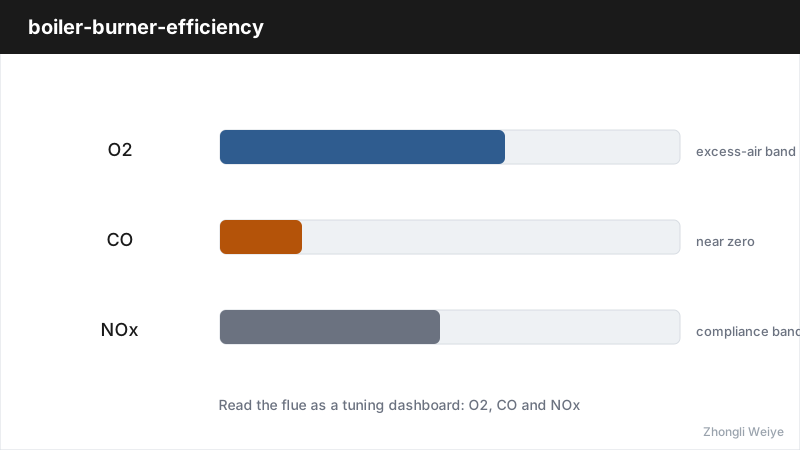
Separating combustion loss from boiler loss
Two distinct things are usually being described as efficiency. Combustion efficiency asks how completely the burner converts the fuel into heat, and it is the figure improved by tuning: less excess air, less unburned fuel, a flame properly shaped for the chamber. Boiler efficiency asks how much of that heat the boiler passes to the water or steam, and it is improved by scale condition, insulation and soot cleanliness. Conflating them leads to wasted effort, because a perfectly tuned burner on a badly scaled boiler still loses money and a clean boiler on a mistuned burner does too.
The two also respond to different symptoms, which is the practical way to tell them apart. A combustion-side problem usually shows in the flue: carbon monoxide, a drifting oxygen reading, visible flame disturbance. A boiler-side problem usually shows in the appliance itself: a slow temperature rise, a stack temperature that will not come down, a flue gas temperature that rises faster than the water temperature does.
Excess air is the largest controllable loss
Every kilogram of air beyond what combustion needs has to be heated from ambient to flame temperature and then carried out of the stack. Because air carries heat and displaces flue gas, the cost of unnecessary excess air is paid twice: the energy that goes into warming it, and the share of the chimney that warm air occupies instead of useful flue gas. It is the reason a burner that reads high oxygen is losing efficiency even though nothing about it looks wrong.
The recoverable amount is often larger than people expect, because burners are deliberately commissioned with a margin. That margin is justified at commissioning, where conditions are unknown, and then left in place indefinitely. Redrawing it on evidence rather than habit is the cheapest efficiency work available, and it is exactly what our guide to air and fuel ratio tuning sets out.
Part-load behaviour is where the plant actually lives
A burner is tuned and tested at full fire. A plant spends most of its hours well below that, and the behaviour down there is where seasonal efficiency is decided. Two failure modes dominate. An on/off burner that cycles loses energy on every purge and start, and each re-light carries a cold appliance behind it. A modulating burner whose curve was never mapped drifts away from its target ratio toward either end of the range, spending most of its time off-target while still producing perfectly acceptable-looking flames.
The cure for the first is turndown, matched to the real load swing rather than to the boiler's nominal capacity. The cure for the second is the mapped curve described in our article on modulation control. What matters for the measurement is that efficiency quoted at full fire tells you very little about either condition.
Flame quality and chamber match
A flame that is correctly proportioned but pointed at the wrong part of the chamber will still lose heat. Flame impingement on refractory shortens its life and eventually forces repairs, and a flame that licks along a cold wall instead of distributing across the heat exchange surface means part of the appliance never reaches working temperature. None of that appears in a combustion measurement, because the burner is doing what it was told.
Soot on the heat exchange surfaces is the other side of the same point. It insulates, it raises stack temperature, and it insulates more as it thickens, which is why a plant that was commissioned well can drift downward without anything obviously changing. Cleaning and re-commissioning recovers most of it, and the flue gas analysis technique for checking it is covered in flue gas analysis.
Efficiency degrades, and nothing announces it
There is no event that marks the day a burner stops performing. The air filter loads, the actuator linkage loosens slightly, a nozzle erodes a little, the combustion chamber deposits another layer of soot, and each contributes a fraction of a percent. Measured once a year, the loss is invisible; measured against a recorded baseline from commissioning, it shows up as a trend well before anyone notices the fuel bill.
That is the argument for treating the commissioning record as a working document rather than a formality. With the fuel, the settings and the readings on file, an annual comparison is quick and tells you which side is drifting. Without it, the only way to recover a percentage is to re-optimise from scratch and watch for the change. Our burner maintenance checklist is arranged around the measurements worth repeating on that cycle.
Frequently asked questions
What is a good efficiency for a gas boiler burner? The figure depends on the appliance and the standard it is measured against, so a number quoted without its conditions tells you little. The more useful question is how the measured value behaves as load falls, since that variation often exceeds the difference between competing burners.
How does excess air affect boiler efficiency? Unnecessary air has to be heated and then vented, so it carries energy out of the stack and displaces flue gas. A burner reading high oxygen is losing efficiency even when the flame looks entirely correct.
Does a modulating burner always save fuel? Not by itself. Modulation saves fuel when the control curve holds the ratio across the range. A burner that modulates but drifts away from its target at part load can perform worse than a well-controlled on/off burner on a steady load.
Why has our boiler got less efficient over time? Gradual accumulation rather than a single fault: a loading air filter, deposits on the heat exchange surfaces, a slightly eroded nozzle and a damper linkage that has lost a little travel. Each is small, and together they are worth measuring against the commissioning record.
How often should a boiler burner be serviced? On the schedule that matches its running hours and the fuel it burns, with the flue measurements repeated at the same points each time so drift is visible. The interval matters less than keeping the readings comparable.
Does a clean burner guarantee good efficiency? No. A clean, correctly adjusted burner loses heat anyway if the appliance behind it is scaled, if the chamber is badly proportioned or if the load profile keeps it away from its best point.
Request a quote
If a boiler is using more fuel than its commissioning record predicts, send the burner model, the appliance and the flue readings at high and low fire. Zhongli Weiye separates the combustion-side losses from the appliance-side ones and tells you which is worth acting on first.
Related products
The parts and product families referenced in this guide:
- where the fuel energy goes
- recovering heat from the flue
- measuring combustion efficiency
- part load and turndown behaviour
- the annual burner service
This guide covers Boiler Burner Efficiency: Where the Fuel Actually Goes. For the exact part that fits your duty, send us the model plate photo and we confirm availability, lead time and a matched quotation.