
Modulation control turns a burner from an on-off appliance into one that follows a load. The servo motor and the air damper actuator have to move together in a fixed relationship, and almost every modulation fault is a failure of that relationship rather than of either device on its own.
What modulation actually changes
An on-off burner runs at one input or not at all, so the process sees full heat or none. A modulating burner varies the input continuously between two limits, which lets the load be matched rather than averaged. On a process with a long thermal time constant that shows up as steadier quality and a cheaper fuel bill, because the burner stops overshooting and shedding heat the process then has to absorb.
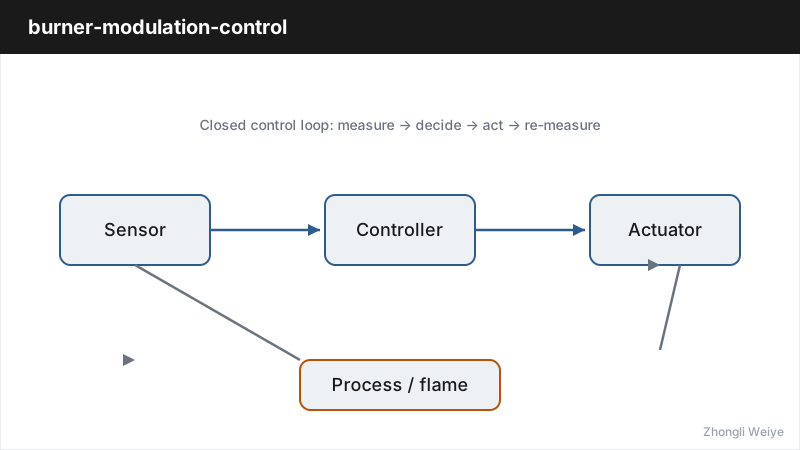
The mechanism is mechanical. One actuator, driven by the servo, positions the fuel control shaft; the other positions the air damper, directly or through a linkage. The controller commands a position, and both actuators follow a stored relationship. That relationship is the curve, and it is what has to be right.
Turndown is where the range ends
The bottom of the range is not a control setting. It is the point where the flame stops holding together, and it is set by combustion physics rather than by the controller. Below it the flame becomes unstable, the burner may fail to light on demand, and the ratio drifts enough to produce carbon monoxide. Most controllers will command a position below the usable limit, so the limit has to be established and set.
Turndown achievable in practice is usually a little worse than the documentation suggests, because the figure assumes a specific inlet air condition and fuel. The turndown notes cover how the low end is established from readings, not a datasheet.
The curve is a calibration
Commissioning the curve means walking the burner from the top of its range to the bottom, recording what each actuator does at every step, and adjusting until the readings agree. Check the ratio at several points rather than the ends, because the middle of the range is where a linkage with slightly different geometry shows up as a drift that never becomes a fault at either end.
Record the positions. A burner whose curve has been recorded can be checked by phone against the numbers a technician expects to find, and one whose curve has not can only be diagnosed by rebuilding it. That is the argument for writing the curve down, and it applies to a replacement servo as much as to the original commissioning.
Where the control signal comes from
The demand reaches the burner as a signal, and the type matters when something behaves strangely. A three-position signal gives the controller full open, full closed and a demand for somewhere between, which it resolves itself. An analogue signal carries the demand directly, so what the panel shows is what the burner was asked for, and that case is far easier to diagnose.
On the load side the demand usually comes from a process controller acting on the burner rather than the valve, and a slow loop is a common source of poor burner behaviour. A process with a long lag will oscillate, because the burner responds to a demand derived from a temperature that has already moved. That is a control loop problem, not a burner fault, and no curve adjustment fixes it.
What a modulating burner cannot do
Modulation holds the appliance between its limits and does not remove them. A burner that must follow a load to a very small fraction may need a different appliance, not a wider curve, and a process swinging between no demand and full demand is still an on-off problem. Which case you have is a question about the load profile.
There is also a stability limit below which the appliance will hunt. If the process demand moves faster than the burner and the process responds to the flame movement, the loop oscillates and never settles. The furnace pressure notes cover the interaction between chamber pressure and burner output on a sealed chamber.
Frequently asked questions
What is the difference between single stage, two stage and modulating burners?
Single stage fires at one input or not at all. Two stage fires at a low input and a high input, halving the step the process sees without continuous adjustment. Modulating varies the input continuously between its limits. The middle option is often the cheapest way to remove the largest step, worth considering before assuming a modulating appliance is needed.
Why does a modulating burner produce carbon monoxide at low fire?
Because the two actuators stop tracking each other at the bottom of their travel. An air actuator that no longer completes its stroke delivers less air as the demand falls, while the fuel shaft continues to close, so the mixture goes rich. A loosened linkage or a fuel valve that does not seal produces the same symptom. Comparing high fire against low fire shows which actuator moved first.
How is the turndown of a modulating burner established?
By walking the burner down until the flame stops holding together, reading the ratio at each step. The usable bottom is the point before stability or the carbon monoxide reading deteriorates, not the lowest position the controller will command. The result depends on inlet air conditions and fuel, so it is worth repeating the walk in another season where the site has that variation.
What causes a modulating burner to hunt?
Usually a control loop rather than the burner. A process with a long thermal lag oscillates because the burner responds to a demand derived from a temperature that has already moved. A badly tuned curve produces a related effect, where the actuators overshoot the demand and correct back. Confirm the curve before changing control settings, since both present similarly.
Does replacing the servo motor require the curve to be reset?
In most cases yes, because the replacement rarely has the same linkage geometry as the unit it replaces, so the stored relationship between fuel and air positions no longer describes the mechanism. A burner commissioned carefully will have the curve recorded, which turns a reset into a comparison against known numbers. That record is worth more than the servo. Our parts cross-reference notes cover identifying the right replacement.
Can a burner that is not designed for modulation be made to modulate?
Not usefully. The fuel control has to hold a continuous position and the air damper has to be linked to it, and an appliance built for two fixed positions has neither. Where deep modulation is needed the answer is a modulating appliance; where a two-step reduction is enough, a two stage burner is cheaper. Our gas burner range covers both.
Request a quote
Zhongli Weiye supplies modulating appliances, the servos and damper actuators that drive them, and the control platforms that hold a demand across a range. Send the burner model, the control platform and the range to be covered, and the recommendation comes back with the parts that fit and what to confirm when the curve is set.
Related products
The parts and product families referenced in this guide:
- servo travel end positions
- air damper travel calibration
- turndown at part load
- modulating burner control platform
- chamber pressure and burner output
This guide covers Burner Modulation Control: Following the Load Smoothly. For the exact part that fits your duty, send us the model plate photo and we confirm availability, lead time and a matched quotation.