
Furnace pressure is the balance between hot gas trying to leave the chamber and cold air trying to get in. Neither side of that balance is dramatic on its own, which is why it gets neglected. The consequence of getting it wrong is not a single large event; it is a small and permanent loss that shows up as a higher fuel bill, uneven product quality and a refractory that ages faster than it should.
Too negative and the chamber leaks cold air
Under negative pressure the chamber is drawing in outside air through every door seal, viewing port and wall penetration it has. That air does not participate in combustion, so it carries heat straight out of the working volume. It also cools the load and the refractory near the leak path, which is where thermal shock and surface cracking begin.
The flame suffers in a way that is easy to misattribute. Cold air entering near the burner dilutes the mixture at a specific point rather than uniformly, and the result is a flame that leans, lifts or wanders. A burner that will not hold a stable flame is often diagnosed as a burner problem when the actual cause is the chamber breathing around it.
Too positive and the useful part escapes
Going the other way, a chamber held too high leaks hot gas out through the same openings, and that gas is at process temperature and carrying recoverable heat. You are paying to heat air that then leaves the building, which is the most expensive way to waste fuel available.
There is a second problem with excess positive pressure, and it is the one that gets treated as a safety matter rather than a cost one. Hot gas escaping at a door or an inspection port meets an operator. Where a chamber is opened regularly, the design pressure has to keep that discharge away from the opening. Slight positive pressure inside the chamber is the condition that makes a furnace safe to open, which is worth remembering when someone asks why the setpoint is not zero.
Control a band rather than a point
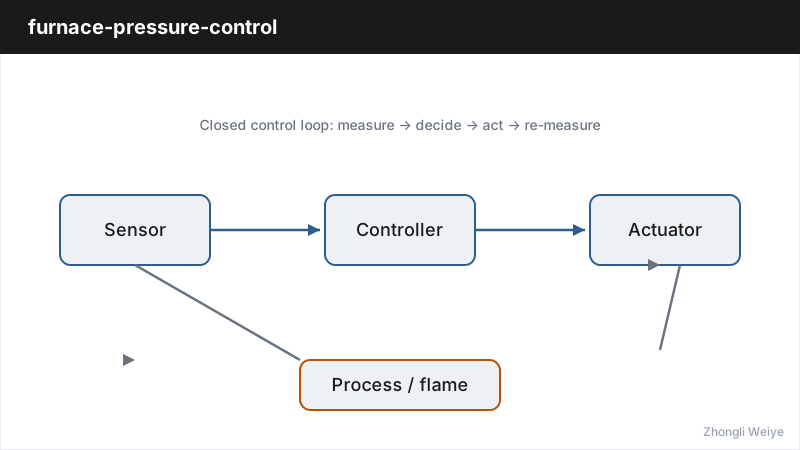
Nobody holds one number. A pressure controller with a furnace pressure probe holds the chamber inside a narrow band around the design pressure, and the exhaust damper moves to keep it there while the burner output changes. Band width matters as much as setpoint: too wide and the chamber swings between cold infiltration and hot leakage through the cycle.
The loop has to move the damper and the burner together. If the damper is slow relative to a burner step, the chamber sees the burner change first and the pressure transient is carried by the damper alone, which is when a hunting loop develops. Tuning for the burner step rather than for the steady state is what stops that happening, and it is the difference between a chamber that settles after a setpoint change and one that oscillates.
Where the probe goes decides what you measure
Probe placement is the detail that decides whether the control works. A probe in the burner stream sees burner output and reads high. A probe near a door reads the pressure at the opening rather than in the chamber, so it measures the leak rather than the condition. The usable position is on the chamber wall, in the flow, away from the burner discharge and away from any wall or opening where the air is already moving.
The tubing matters for the same reason. Impurities in the impulse line, condensate, or a tube run that moves with the fan causes a signal that jitters even when the chamber pressure is steady, and the loop responds to the jitter by moving the damper, which changes the pressure it is trying to hold. Pressure switches and transmitter type devices are also worth matching to the range around the design point rather than to a much wider span.
How pressure relates to the air side
Pressure is not an independent setting. It is the result of the burner output, the exhaust damper, the furnace leakage and the air supply all acting together, so any change to one of them moves it. A combustion air blower adjustment, a filter that has started to block, or a door left open during charging all show up first at the pressure signal.
That is useful in practice. A drifting pressure setpoint on an otherwise healthy burner usually points at the air side rather than the chamber. Where the loop is combined with the burner control, the damper actuator and its travel need to be checked against the chamber leakage, because an actuator that cannot reach full travel cannot hold the band at high burner output.
Frequently asked questions
Why should a furnace be slightly positive?
It keeps hot combustion products from leaking out at doors, viewing ports and wall penetrations, and it makes the chamber safe to open because discharge happens at the designed leak paths. A chamber held slightly negative does the opposite and draws cold air into the working volume.
How much pressure variation is acceptable?
A narrow band around the design pressure, rather than a fixed tolerance. How wide that band can be depends on the leakage of the chamber and the sensitivity of the load to temperature variation. Where the load is sensitive, the band is set by the product rather than by what the burner can achieve.
Where should the furnace pressure probe be fitted?
On the chamber wall, in the flowing gas, clear of the burner discharge and clear of any opening or wall where air is already moving. A probe in the burner stream reads burner output instead of chamber pressure, and one near a door reads the leak rather than the chamber.
What causes a pressure control loop to hunt?
Usually the response is slower than the disturbance it is correcting, or the measurement is noisy. A damper too slow for a burner step, a probe in turbulent flow, and a saturated or poorly ranged transmitter all produce the same symptom. Tuning for the burner step rather than the steady state usually resolves it.
Does a blocked air filter change furnace pressure?
Yes. Less air through the burner changes the pressure the burner develops in the chamber, so the controller moves the exhaust damper to compensate and the pressure setpoint appears to drift. A rising pressure signal alongside falling air temperature is often a filter condition rather than a chamber fault.
How often should furnace pressure be checked?
The trend is more informative than a spot reading, so log the signal and compare across a period. Check the impulse line and probe condition whenever the reading is noisy, and verify the band width after any change to the chamber, the burner output range or the exhaust arrangement.
Request a quote
Send the chamber arrangement, the burner output range and how the exhaust is currently damped, and we can look at what the loop needs to control. If the problem you are chasing is fuel use that crept up over a season, a description of the chamber openings and where the air is entering is usually more productive than a pressure figure, because it points at the leakage path.
Related products
The parts and product families referenced in this guide:
This guide covers Furnace Pressure Control: Why a Few Pascals Decide Quality. For the exact part that fits your duty, send us the model plate photo and we confirm availability, lead time and a matched quotation.