
A combustion air blower exists to deliver air at a pressure, not simply to move a volume of it. The burner cares about what it sees at the windbox, because pressure there is what sets penetration and mixing, and mixing is what sets flame stability and how well combustion completes. A blower that delivers the right volume at free air and the wrong pressure at the port gives a burner that will not hold its air to fuel ratio.
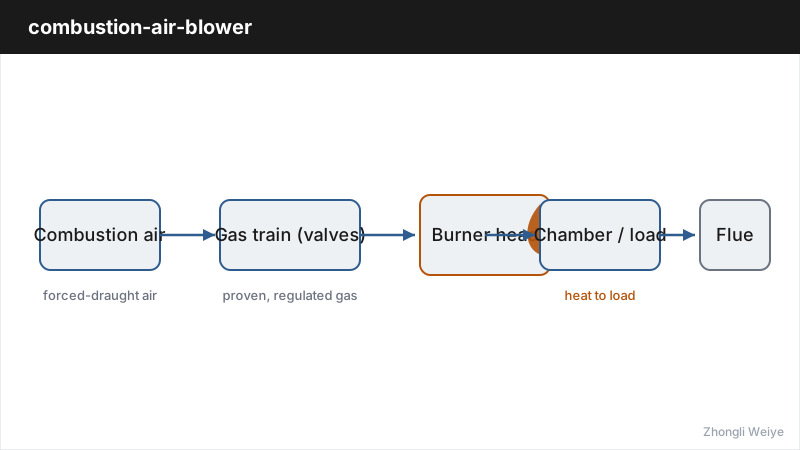
Pressure at the port is the specification
Between the fan and the burner there are filters, plenums, dampers, elbows and the burner windbox itself, and every one of them takes static pressure out of the stream. A fan curve quoted at free air tells you nothing about what arrives. The figure that has to be satisfied is the pressure at the burner inlet at full fire, which is the fan curve read at the system resistance that actually exists.
That is why the blower has to be selected against the duct arrangement rather than from a volume figure alone. Doubling the flow through a fixed duct raises its resistance well beyond double, so a system that needs more air than the original design will need a different fan curve, not a faster fan. Burner air requirements and the damper actuator range both feed into that calculation.
Where the working point sits on the curve
A fan is a system component, not a fixed output. It has a curve, and the ductwork has a resistance curve, and the operating point is wherever the two intersect. Move the intersection by closing a damper or fouling a filter, and the delivered flow drops while the pressure across the system rises.
This matters because burners are usually run with the damper wide open at full fire. If the fan was selected so that full fire sits at the edge of its useful curve, then every bit of added resistance pushes the operating point into a less stable part of it, which shows up as falling air pressure and a flame that hunts. Selecting with margin means the normal operating range stays on the flat, predictable part of the curve rather than at its edge.
Air pressure and what it does to stability
Stable air pressure is what lets a burner hold the bottom of its turndown. As firing rate falls the flame gets shorter and less energetic, and the air pressure it depends on becomes a larger fraction of the whole margin. When air pressure sags at low fire, the flame lifts, the detector loses it, and the burner locks out at exactly the load it should be holding most easily.
A fan that has degraded produces the same symptom gradually, which is why it gets misread as a detector fault. Watching air pressure against firing rate over a period separates the two cleanly: a detector problem shows as intermittent loss at one load, a fan problem shows as a slow downward trend across the whole range. Turndown ratio covers what the low-fire end depends on.
The intake is where the trouble starts
Filtration protects the impeller, and on an industrial site the intake is the part that degrades fastest. Inlet guards, filters and screens progressively fill with whatever the site produces, and the resistance they add moves the operating point exactly as a closed damper would.
Cleaning restores the fan to something close to its original curve, which is why a blower that seems to have lost power often recovers fully after cleaning and then loses it again. Impeller erosion from grit is a separate and permanent problem: it unbalances the wheel, which shows up as vibration, bearing wear and rising noise. Siting the intake away from the dust source, and specifying a filter that can be cleaned rather than replaced, are the two decisions that determine which of those problems appear.
Tying the blower to the control loop
Air has to move with fuel. If fuel output changes and air pressure does not follow, the ratio moves, and every burner is a compromise between the two. The control has to track air with fuel across the whole range, and the servo and damper actuator arrangement has to hold the point accurately at the low end where the pressure differential available is smallest.
Air proportional control is the arrangement that achieves this, but it depends on a clean measurement. A blocked filter, a loose linkage or a damper actuator that has lost its feedback will all make the loop fight itself. Air to fuel ratio tuning covers what the measurements should look like once the loop is working, and combustion air fundamentals covers the arrangement between fan, damper and windbox.
Frequently asked questions
How is a combustion air blower sized?
Against the pressure the burner needs at its inlet at full fire, plus margin, with the duct resistance of the actual installation included. Sizing on volume alone gives a fan that delivers the air quantity at free air and not the pressure at the port, which is what the burner actually depends on.
Why does a blower lose power over time?
Most often because the intake filter or guard has progressively fouled, which adds system resistance and moves the operating point along the fan curve. Cleaning normally recovers it. If it does not, the impeller may be eroded by grit, and that is permanent and shows up as vibration and bearing wear.
What happens when air pressure drops at low fire?
The flame shortens and lifts because it has less energy to hold itself together, and the detector can lose it, causing a lockout at the load the burner should be holding most easily. A slow downward trend in air pressure across the whole range points at the fan or the filter rather than at the detector.
Does combustion air pressure affect turndown?
It does directly. At low firing rate the air pressure the flame depends on is a larger fraction of the available margin, so any sag there costs turndown before it costs anything at full fire. Stable air pressure across the range is what allows a burner to hold its rated low-fire behaviour.
Why does a closed damper or a blocked filter change fan output?
Because ductwork has a resistance curve, not a fixed resistance. Increasing restriction moves the operating point along the fan curve to lower flow and higher pressure. Burners commonly run with the damper wide open at full fire, so any added resistance pushes the operating point toward the edge of the fan curve.
How much air margin should a blower have?
Enough that normal fouling and damper position keep the working point on the flat, predictable part of the fan curve rather than at its edge. Selecting exactly to the calculated requirement leaves no allowance for a filter that has been running for a season, which is when the operating point moves furthest.
Request a quote
Send the burner output range, the duct arrangement and the filter type, and we can check the air side against the system rather than against free air. If a blower has lost power over time, adding the fan type and whether cleaning the filter restored it separates the two causes, and that single detail usually settles it.
Related products
The parts and product families referenced in this guide:
- air damper actuator
- damper servo motor
- air proportional control
- combustion air blower
- combustion air supply
This guide covers Combustion Air Blower: Why Forced Air Changes the Flame. For the exact part that fits your duty, send us the model plate photo and we confirm availability, lead time and a matched quotation.