
Combustion tuning is the act of putting a burner on the leanest mixture it will burn cleanly, and holding that point across the whole firing range. Done well it is the cheapest efficiency available on almost any boiler, because nothing is bought and nothing is rebuilt. Done badly, in the sense of trimming a fixed number of turns off a screw and walking away, it produces a burner that is efficient at the one point it was adjusted and drifting everywhere else.
The target is a band, not a number
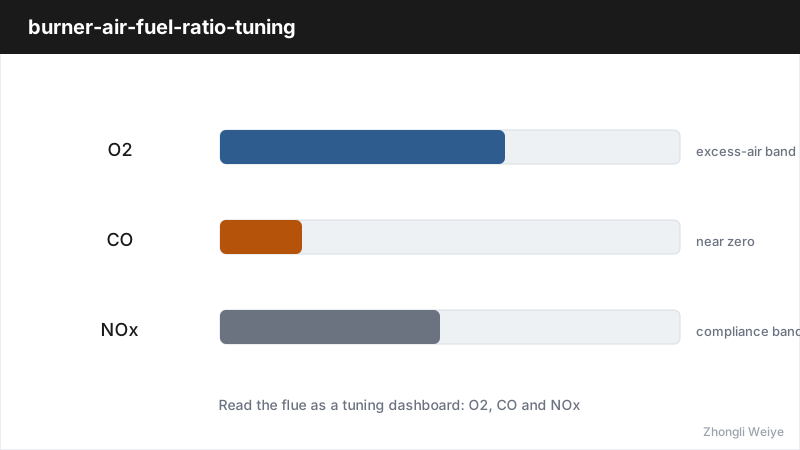
Every combustible fuel has a fixed mass of air that will burn it completely, and running below that figure produces carbon monoxide and soot, which is both a combustion failure and an emission problem. Running above it costs fuel, because every extra kilogram of air has to be heated and then vented. So the practical target sits just on the lean side of complete combustion, and it is a band rather than a point because the burner has to tolerate load changes, fuel density variation and the small errors that come with any control system.
That is why a specification written as a single oxygen figure is a poor instrument. What matters is that carbon monoxide stays at zero across the range while oxygen sits as low as the burner can hold. Where a site has an emissions limit, the target moves further toward the lean end, and the remaining question becomes how far the burner can be pushed before the flame starts to suffer.
Why the flue reading is the only honest measurement
Nothing on the burner tells you the ratio. The fuel valve position tells you how much fuel is commanded, the damper position tells you how much air the actuator has been told to admit, and neither reflects what actually happened. A burner running rich will show a perfectly normal valve and damper position while the flame sits in the wrong place, because the air side compensated automatically or the fan was never delivering what the design assumed.
Measuring in the flue closes that gap, because it reports the combustion products rather than the intentions. Oxygen in the flue is the proxy for excess air, and carbon monoxide is the evidence that combustion is incomplete. Our guide to flue gas analysis covers the instrument choices and what each reading can and cannot tell you.
One curve across the whole range, not one setpoint
A burner that is correct at full fire is usually wrong at low fire, and the reason is geometric. The fuel valve and the air damper do not have the same flow characteristic, so a linear relationship between their positions does not produce a constant ratio. On many burners the ratio drifts progressively richer or leaner toward the bottom of the range, which means the burner that was adjusted at full fire has been running off-target every time the load dropped.
What resolves this is a mapped relationship between the two actuators, which is what the servo motor and the damper actuator deliver when their linkage is set up against measured points rather than assumed ones. Taking readings at several positions through the travel, adjusting the air side at each, and recording what the flue said produces a curve the burner can actually hold. Our article on burner modulation control covers how the mapping is configured once you have the data.
Staying inside the stability window
There is a limit below which the lean end stops being free and starts costing stability. A flame that is too lean lifts off the burner, blows out under a draught, or oscillates; a flame that is too rich smears, lights unevenly and leaves soot on the chamber. Neither failure is acceptable, and the interlock will eventually respond to the second one by locking out during a flame failure. Tuning therefore stops at the point where the flame is still well anchored, not at the lowest oxygen reading the instrument happens to show.
Two indicators tell you the window is closing before the lockout does. A falling flame signal during the ignition or proving phase means the flame is becoming harder to hold, and it usually moves before anything in the flue changes materially. Soot appearing on the chamber surfaces says the same thing from the other end.
What invalidates a tune, and the record that survives it
A tune is a snapshot of the burner against a fuel and an air supply, and several ordinary events move it. A fuel change alters the density and the combustion characteristics. An air filter loading or a duct leak shifts the air the burner receives. A nozzle change alters the fuel delivery. Seasonal ambient temperature changes the air density the fan works against. In each case the previous numbers are no longer evidence of anything.
What makes this manageable is a written record rather than a memory: the fuel, the burner settings at each measured point, the flue readings taken, and the date. With that, a later fault is diagnosed against a known baseline instead of by trial and adjustment on a running appliance.
Frequently asked questions
What air to fuel ratio should a burner run at? Slightly lean of the point where complete combustion occurs, with carbon monoxide at zero. The margin exists so the burner tolerates load and fuel variation; how large it should be depends on how steadily the fuel supply and the air path hold up.
How do I know if my burner is running lean or rich? A flue reading answers it directly. Low oxygen with a clean flame usually means more air than the duty needs; low oxygen with a smoky or yellow flame means the mixture is short of air and combustion is incomplete.
Why does my burner need re-tuning every year? Usually because something on the air side has moved rather than because the tune was wrong. A loading filter, a leaking duct and a recirculation path all reduce or degrade the air, and the burner responds by opening the damper further to compensate.
Should I tune at full fire or low fire? Establish the curve across the range rather than at one point. Full fire sets the top of the curve, but the part-load behaviour is where most of the running hours are spent and where the drift usually appears.
Does altitude affect the air fuel ratio? Yes. Air density falls with height, so the same volumetric flow carries less mass of oxygen, and a burner selected and tuned at sea level may need adjustment when installed higher.
Can I tune a burner without a flue gas analyser? You can observe the flame and make an approximate adjustment, but you cannot verify the result. Judging by flame appearance alone leaves the difference between a good tune and a slightly rich one invisible, which is where the fuel cost and the carbon monoxide come from.
Request a quote
If a burner will not hold a tune, drifts as the load changes, or sits outside its emission target, send the burner model, the fuel, the fuel supply conditions and a flue reading at high and low fire. Zhongli Weiye works through the air path and the curve with you and tells you which part of the system the evidence points at.
Related products
The parts and product families referenced in this guide:
- flue gas analyser readings
- modulating fuel valve servo
- air damper positioning
- modulation control setup
- turndown ratio selection
This guide covers Burner Air/Fuel Ratio Tuning: Finding the Sweet Spot. For the exact part that fits your duty, send us the model plate photo and we confirm availability, lead time and a matched quotation.