
A heat recovery burner is a burner packaged with a device that takes energy out of the exhaust and puts it back to work, either into the incoming combustion air or into the process itself. In most heating systems the stack is the largest single energy loss, which is why recovery usually returns more saving per unit of capital than any burner-side improvement. This guide compares the three routes that genuinely work with burners, what each one costs to run, and how to tell whether your duty is hot and continuous enough to repay the hardware.
Start from the exhaust, not from the burner
Recovery decisions go wrong when they start from the burner nameplate. The burner output tells you what you are putting in, not what is coming out. What matters is the exhaust temperature and the mass flow leaving the stack, because together they set the energy available to reclaim. A burner firing into a chamber with a great deal of excess air leaves more energy in the flue than a burner running lean, even at the same fuel input. That is why a combustion survey, not a catalogue page, is the correct starting point.
Two numbers carry most of the argument: the exhaust temperature and the annual run hours. Typical industrial flue gases leave a furnace somewhere in the 150 to 400 deg;C range depending on how much excess air and how much of the heat the process actually absorbs, and high-temperature continuous processes such as forging or reheating run far above that. Where the gas is cool and the plant is intermittent, the recoverable fraction is small and the extra surface area rarely clears the investment.
The payback calculation that follows from those two numbers is short and it is the only honest test. Take the exhaust temperature and flow from the survey, estimate the fraction recovery could realistically return given your run hours, multiply by your fuel cost, and compare the annual saving against the installed cost and the added maintenance. Running it first stops the conversation drifting toward whatever technology happens to be available rather than what the duty can support.
Recuperation: preheating the combustion air
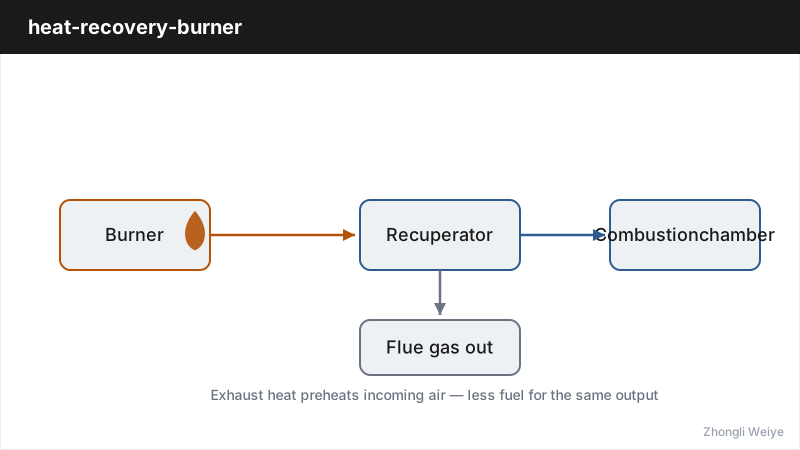
A recuperator is a heat exchanger between the exhaust stream and the incoming air. Because the air arrives at the burner already hot, the flame burns at a higher temperature for the same fuel flow, and more of that heat lands in the workpiece instead of the flue. Recuperators use metal or ceramic surfaces and have few or no moving parts, which makes them the default route for a wide range of furnaces. They also ship as one package with the burner, so specifying recovery does not mean designing a separate system.
The limitation is the approach temperature. You cannot cool the metal below the acid dew point of the flue gas without risking corrosion, so a recuperator has to keep its cold side above roughly 150 to 180 deg;C to stay clear of sulphuric acid attack. That single constraint caps the air preheat a metal recuperator can deliver, typically into the 200 to 400 deg;C region, and it is why fired tubular recuperators are built in sections so that one cold section failing does not shut the plant.
Regeneration: storing heat in a ceramic bed
A regenerative system alternates the exhaust and the incoming air through a hot ceramic bed. On the exhaust stroke the bed soaks up heat; on the air stroke it gives that heat back to the combustion air. Because the bed is a store rather than a barrier, it can be far hotter than the gas it handles, so air preheat well above what a metal recuperator allows becomes possible, and the recovered fraction rises accordingly. This is why regenerative burners dominate reheating and forging furnaces.
The extra capability is paid for in valving and control. The system has to flip between beds without losing flame stability and without letting exhaust short-circuit into the air stream, and a typical pair of high-temperature valves cycling every few seconds is a far more active wear item than anything on a recuperated burner. Bed size and cycle timing have to be matched to the process rather than left at a generic setting, because too long a cycle wrecks the temperature swing the bed is supposed to smooth out. Budget for valve maintenance from the first year, not as a surprise.
Process-side recovery often wins on simplicity
Not every recovery route preheats air. In many plants the better move is to send the exhaust heat directly into the material. A fresh charge entering the furnace, a drying section downstream, a boiler feed stream or a curing stage are all heat sinks that already exist, and feeding them removes the need for a second exchanger in the combustion path entirely. Where the process has a natural sink, this route is frequently the cheapest way to cut fuel use, because you are not adding pressure drop to the burner and not adding a control loop that has to stay in step with the burner.
The limitation is that the sink has to be at a useful temperature and large enough to absorb what you give it. A product that tolerates 200 deg;C will not take heat from a 900 deg;C exhaust without a preheat stage of its own, and a sink that is already fully loaded leaves nowhere to put the recovered energy. Price process-side recovery first when a suitable sink exists, then fall back to air preheat when it does not.
Recovery changes the burner and the emissions case
Preheated air is not a passive add-on. It changes flame geometry, flame temperature and the pressure the burner sees at the port, so the burner has to be matched to the recovered condition rather than to a free-air calculation. A unit sized on free-air air requirements will be starved of volume once the air arrives warm and expanded, which shows up as a lifted, unstable flame rather than an obvious shortage. The damper actuator and servo arrangement also has to hold the ratio across a wider swing than on a cold-air burner.
Higher flame temperature also raises thermal NOx, and that is the tension at the centre of any recovery project. Preheating buys efficiency and costs emissions headroom, so the two have to be solved together from the start. Staging, flue gas recirculation and low-NOx burner geometry are the usual levers, and each changes how the recovery system behaves. A retrofit that adds recovery to an existing burner and discovers the NOx problem afterwards generally ends up with a smaller recovery target than it started with, because the combustion has to be pulled back to make the emissions number.
Frequently asked questions
When is recuperation better than regeneration? Recuperation is the right default for moderate temperatures and straightforward duty because it has fewer valves, fewer control states and a lower installed cost. Regeneration earns its extra complexity only where very high air preheat and a much larger recovered fraction are needed, which in practice means hot, continuous furnaces such as reheating or forging.
Does heat recovery increase NOx emissions? It can, and it usually does to some degree, because preheating combustion air raises flame temperature and thermal NOx formation rises with it. That is why low-NOx measures belong in the initial design rather than being added after a test failure, since pulling the combustion back to meet a limit also reduces the recovery you can actually take.
How do I know whether recovery will pay back? Establish the exhaust temperature and mass flow from a combustion survey, estimate the recoverable energy against your annual run hours, then compare the annual saving with installed cost and added maintenance. Hot continuous processes repay comfortably; cool intermittent ones generally do not. The arithmetic is the only honest test.
Can the exhaust preheat the load instead of the air? Yes, and where a suitable heat sink already exists it is often the simpler and cheaper route, because it avoids adding a second exchanger and its pressure drop to the combustion path. The catch is that the sink must be able to accept the temperature you are offering it without its own preheat stage.
What fails most often in a recovery system? In recuperators it is leakage between the air and exhaust streams at seals and joints, which shows up as poor efficiency and a burner that will not hold its air to fuel ratio. In regenerative systems it is high-temperature valve wear and bed contamination. Both are manageable, but both belong in the maintenance plan from day one.
Can an existing burner be retrofitted with heat recovery? It is often possible, but the burner should be checked first rather than assumed suitable. Preheated air changes the volume and pressure the burner sees at its inlet, and a unit sized on free-air requirements may be starved once the air arrives warm and expanded. Confirm the burner can hold its ratio across the recovered condition before committing.
Request a quote
Send the exhaust temperature and flow from a survey, your annual run hours and the fuel you burn, and we will model the recoverable energy against the installed cost before recommending a route. If a system is already in place and not performing, add what the recovery device is and whether the burner was ever matched to preheated air, because those two details usually settle it.
Related products
The burners and control parts that recovery work usually involves:
- gas burner range
- fuel oil burner range
- air damper actuator
- damper servo motor
- burner program controller
This guide covers Heat Recovery Burner: Capture Stack Energy Before It Escapes. For the exact part that fits your duty, send us the model plate photo and we confirm availability, lead time and a matched quotation.