
An interlock is a device whose only job is to say no. It does not make the burner safer by improving anything; it makes the burner safe by preventing a step from happening, and the design question is never whether the interlock is good but whether the condition it reports is the one that matters.
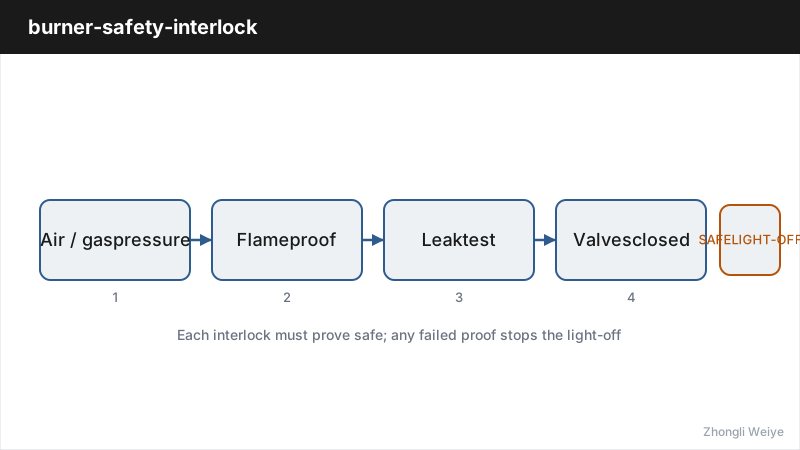
What each device can and cannot prove
A gas pressure switch proves that the pressure in the pipe it is mounted on is above or below a setpoint when it operates. It does not prove the gas is the right gas, that the pipe upstream is unblocked, or that the valve downstream will open when commanded. It is a local measurement with a threshold, and its value comes from being mounted where the condition it reports is the one that matters.
A flame detector proves that a flame is producing a signal it recognises. It does not prove the flame is the right shape, at the right place, or burning with the right ratio. An ionisation detector proves a flame is enveloping its electrode; a flame that has moved away and is burning well will fail the proof, a limit of the device rather than a fault in the flame.
Double block and bleed is about proof, not redundancy
The reason gas trains carry two shut-off valves in series is often described as redundancy, which is close but misses the point. A single valve cannot prove that it is closed. Two valves with a monitored volume between them can: the volume is pressurised, the valves are closed, and if the pressure decays then one is passing.
This is what a valve proving system does, and it is why the bleed volume between the valves is deliberately small. The test looks for a leak rate, and a small volume reaches a detectable decay quickly. A large monitored volume takes proportionally longer to prove, which means a longer start sequence for no additional safety.
The bleed is the part people misunderstand
The volume between the two valves is normally vented, and it is the path that makes the test work: gas passing either valve accumulates there and shows up as a pressure change. Where the bleed is blocked, or a valve has been piped out so the volume cannot be monitored, the test can still pass while providing nothing, because there is no place left for a leak to show up.
The solenoid valves in the train are a matched pair with a monitored space between them, and a replacement that changes the piping arrangement is not a like-for-like swap even when the valve is identical. Which valve failed is also worth establishing first, since a test that passes on one start and fails on the next points at one valve rather than the assembly.
High and low limits cover different failures
A single pressure switch on the gas line protects against too little gas. A second set to open on excess pressure protects against a different failure entirely, and the two are not redundant. High gas pressure at the burner produces a flame that lifts and may blow out, and the low-pressure switch is perfectly happy throughout that event.
This is the general pattern worth understanding: each interlock covers a failure mode the others do not. Air pressure, gas pressure, flame presence, chamber pressure and the leak test each describe a different way the burner can be unsafe, and a scheme is complete when the list of ways is covered rather than the list of devices being long.
Chamber pressure is an interlock people forget
Furnace and chamber pressure protection is often fitted and then ignored, because on a burner that runs steadily the condition does not change. It matters at the moments nobody is watching: when a door is opened, when an exhaust fan fails, or when a process step changes the chamber pressure. A burner firing into a chamber that has gone positive puts combustion products into the building.
Where a chamber is under positive pressure, the interlock is what stands between a fan failure and a room full of hot gas. Chamber pressure control and the interlock are related but not the same, and a burner with one does not automatically have the other.
Testing an interlock means testing the proof
An interlock is verified by making its condition false and confirming the burner responds, not by confirming the burner runs while the condition is true. Running proves nothing, because a failed interlock that happens to be permissive is invisible in normal operation. This is why verification is a deliberate exercise with a valve closed or a pressure bled down, and why it belongs on a schedule rather than only at commissioning.
The record of that test is worth keeping, because the commonest interlock fault is not a failed device but one jumpered during an earlier emergency and never restored. Nothing in the burner's behaviour tells you that. Only the record will.
Frequently asked questions
What is a safety interlock on a burner?
It is a device or condition that must read safe before the sequence can continue. Pressure switches, flame detectors and valve proving systems are all interlocks, and together they form the chain that makes a light-off safe rather than likely to work.
Why are there two gas valves instead of one?
Because a single valve cannot prove it is closed. Two valves in series with a monitored volume between them let the system show that neither is passing, which turns an assumption about valve integrity into a measurement.
How does a leak test interlock actually work?
The volume between the two shut-off valves is pressurised, the valves are then closed, and the system watches for pressure decay. Gas passing either valve raises the pressure in that volume. Only a volume that holds its pressure lets the start proceed.
What does a high gas pressure switch protect against?
Excess pressure at the burner, which lifts the flame and can blow it out or push it back into the head. A low-pressure switch gives no warning of that, since both read a healthy supply while the flame is forced somewhere it should not be.
Is it ever acceptable to bypass an interlock?
No. The interlock being bypassed is the one that would have detected the fault being hidden. A bypass trades a stopped burner for a running one with the protection removed, and the fault continues regardless.
How often should interlocks be tested?
On a defined schedule, and after any work on the gas train, the wiring or the controller. A test means forcing the condition false and confirming the burner stops, then restoring it and confirming it runs. A record of each test makes the schedule meaningful.
Request a quote
Send the burner model and the fuel, and we can identify which proving devices the design uses and what a replacement part needs to match. If you are replacing a device after a fault, the burner model plus the part number is usually enough, and for a valve proving arrangement it is worth confirming the piping too.
Related products
The parts and product families referenced in this guide:
- paired shut-off with a monitored bleed
- pressure decay proving on the gas train
- separate limits for low and high gas pressure
- holding the chamber slightly negative
This guide covers Burner Safety Interlock: The Proof Devices That Refuse to Light Unsafe. For the exact part that fits your duty, send us the model plate photo and we confirm availability, lead time and a matched quotation.