
The automatic shut-off valve in a gas train is the component that makes an automatic burner safe rather than merely automatable. It is held open by an energised coil and returned by a spring, so the failure mode is the safe one: lose the power, lose the signal, or lose the proof of flame and the valve closes without waiting for anyone to act.
What makes a shut-off valve different from any other valve
Three things separate a safety shut-off from a modulation valve, and they are all about behaviour at the moment of failure. The closing time has to be short enough that no hazardous quantity of gas passes the valve after the fault is detected. The seat has to be tight enough that a closed valve is a credible barrier rather than a restriction. And the valve has to be capable of closing against the pressure and flow it actually sees, not just against a datasheet figure.
A valve that eventually shuts is a defect even if it does so eventually. If the fault that triggered the trip is fast developing, a slow valve lets gas continue to flow while the burner is in an unsafe state, and the proof of flame that should have stopped it arrives too late to matter. This is the difference between a valve that is nominally closed and one that is proven closed.
Why two valves in series
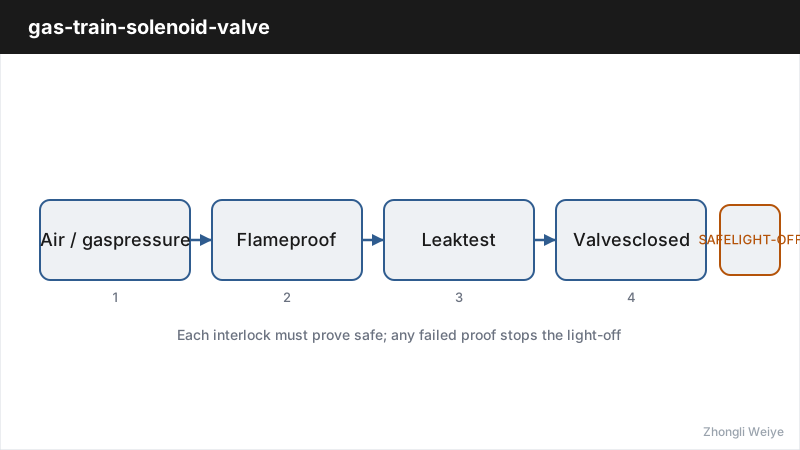
Two valves in series give two independent barriers, and more importantly they give a testable cavity. The controller closes the downstream valve first, opens the upstream valve, and then checks whether the cavity between the two holds pressure for a defined period. A valve with a weeping seat cannot pass that test, so a single defect is found before light-off rather than during it.
This is the part of the arrangement that is easy to leave out. Some installations fit a single automatic valve and rely on a manual upstream isolation, which is perfectly normal for a small appliance burner but is not the arrangement that supports an automatic industrial sequence with a proved interlock. Where two are fitted, both automatic shut-off valves have to be the type rated for that service, and both coils have to match the burner supply.
Sizing and how a wrong valve fails
Correct sizing is not about matching a nominal diameter. It is about the flow coefficient across the fully open valve at the minimum inlet pressure, because a burner at low inlet pressure with an undersized valve in the train will not receive its rated flow. Where the valve is significantly oversized, the practical effect is different and less obvious: it can chatter at part load, and chatter wears the seat and the coil, which is exactly the wear that later prevents a clean close.
Upstream of the train, filtration is the other thing that decides how long a valve lasts. A strainer or filter that is too coarse lets debris reach the seat, and a damaged or missing filter lets it arrive faster. Burner fittings and strainers are cheap relative to a valve replacement, and they are the reason valves in the same train fail at different rates on otherwise identical burners.
Coil failure and how it presents
A coil that will not lift is the most common failure and is easy to diagnose: the burner reports a valve fault and nothing happens when the output is commanded. A coil that lifts and then drops out under load, or one that runs hot enough to degrade its own insulation, behaves differently and is harder to attribute without measurement. Voltage and frequency have to match the burner exactly, because a coil designed for a different supply will either not pull in or will overheat.
Humidity and mechanical vibration matter as much as the electrical side. A valve mounted on a pipe run that carries vibration will develop a coil failure sooner than one on a rigid mount, and a humid environment attacks the coil winding. Neither is visible on the valve itself, which is why the mounting arrangement belongs in the enquiry as well as the model number.
Testing rather than assuming
The leak test is the part most often skipped. A burner that lights reliably for months has still lost its cavity test the first time a seat started weeping, and the next light-off is when that shows up. Commissioning a new train, and any service that opens a union downstream of the valves, should both be followed by a real leak test rather than a visual check of the fittings.
Valve selection and the surrounding regulator and train arrangement are considered together, because the valve has to close against the pressure the train actually delivers at its lowest supply condition. The commissioning checklist covers where a leak test sits in the sequence, and the safety valve guide goes into the wider interlock picture.
Frequently asked questions
Why do gas trains use two solenoid valves?
Two in series give two independent barriers and a cavity that can be leak tested. The controller closes one valve and checks whether the space between holds pressure. A valve with a weeping seat fails that test and is found before light-off instead of during the next ignition attempt.
How fast does a gas shut-off valve close?
Fast enough that no hazardous quantity of gas passes after a fault is detected, which is why closure time and seat tightness are the specifications that matter rather than the nominal size. A valve that hangs or closes slowly defeats the sequence that depends on it, regardless of how well it eventually closes.
What causes a solenoid valve to fail to open?
A failed coil, an incorrect coil voltage or frequency, a failed rectifier on an AC coil, or debris on the seat. Coil failure is the most common and shows up as a valve fault with no movement. Supply voltage and frequency have to match the burner exactly.
Does a weeping shut-off valve matter?
Yes. A small leak that passes without being noticed becomes a gas consumption cost, an unburned gas risk in the flue path, and eventually enough loss of pressure to affect burner behaviour. It is also the failure that makes the cavity leak test necessary, and the reason the test is done at every light-off.
How often should the gas train be serviced?
On a schedule set by the burner hours, the fuel quality and the filtration arrangement rather than a fixed calendar. In practice that means strainer inspection, a leak test after any joint is broken, and coil replacement when resistance has drifted or the valve has run hot. Records across the train are more useful than intervals alone.
Does valve size affect reliability?
It can. An oversized valve may chatter at part load, and the vibration wears both the seat and the coil, which is the wear that later stops a clean close. Correct sizing means the flow coefficient at the minimum inlet pressure, so the burner receives its rated flow on a low supply day.
Request a quote
Send the burner model, the gas supply pressure range and the train arrangement you have, and we can confirm valve type, coil supply and whether the installed arrangement supports a proved cavity test. If a valve has failed on a burner that has otherwise been reliable, sending the old valve with the enquiry usually settles whether the cause was electrical, hydraulic or a dirty upstream strainer.
Related products
The parts and product families referenced in this guide:
- automatic shut-off valve
- train pressure regulator
- upstream strainer and union fittings
- commissioning checklist
This guide covers Gas Train Solenoid Valve: The Fast-Closing Safety Link. For the exact part that fits your duty, send us the model plate photo and we confirm availability, lead time and a matched quotation.