
A safety shut-off valve is the component the whole gas train is arranged around. Everything else on that train exists to feed it, to prove it or to detect what happens when it fails. Two valves in series is not ordinary redundancy: a single seat cannot be assumed to seal, and the consequence is not a nuisance trip.
What double block and bleed actually gives
Two shut-off valves in series isolate a section of pipework from both the supply and the downstream side. The space between them is vented, so anything passing the first valve is carried away rather than accumulating. That turns a single leak into a detectable event: the bleed path means the pressure between the valves falls, and a pressure switch sees it.
With one valve, a slow leak passes downstream and the installation has no way of knowing. The gas reaches the burner whether or not the valve meant to stop it, and the only evidence is a behaviour change nobody connects to a closed valve. That is a stronger argument for two than the cost difference.
Valve classes decide what a failure means
Safety shut-off valves are built to a class describing how they behave when they close, and that class is what makes a valve acceptable on the safety chain rather than merely functional. The figures cover the pressure at which the valve seats and the leakage permitted afterwards. A valve slow enough to pass a significant volume before seating is a different proposition, whatever its label says about flow capacity.
This is where a general-purpose valve fitted in error does real harm. A valve chosen for its pipe size and coil voltage can be correct on both and still be wrong for the duty, because closing behaviour is not visible in a catalogue listing. The safety interlock notes set out which parts of the chain carry this requirement.
Proving is the only real evidence
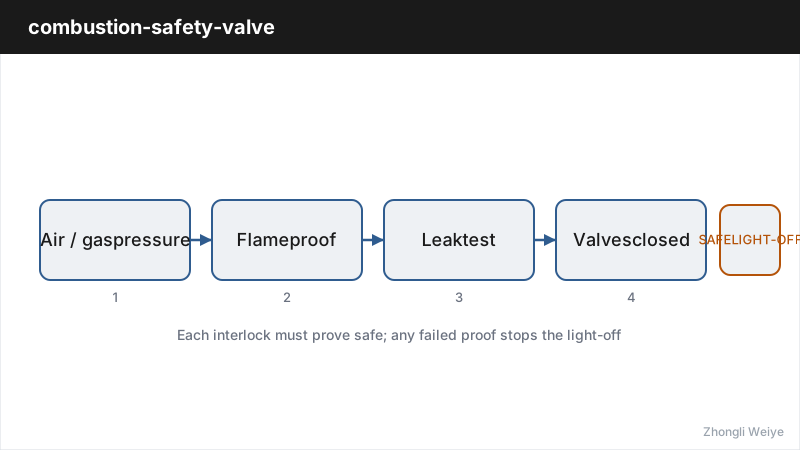
Closing a valve is not the same as sealing it, and the only way to know which has happened is to test it. A proving system pressurises the section between the valves and watches the pressure, refusing to start the burner if it decays faster than the valve should allow. Without a proving device, the equivalent is a pressure decay test on the installation, repeated after any valve change.
The test is only as good as its timing and threshold. Too short and a slow leak passes; too long and every start is delayed. The figures belong to the valve class rather than the installation, another reason to establish the class first. Our valve proving range covers the devices used to run that cycle.
What a failed test actually means
A valve that will not pass a proving test has a seat that is not sealing, and the possibilities are limited. Debris in the seat is most common, often from work done on the pipework with the valve in place. A scored seat comes from the same history. A failed-open coil, or a valve wired in parallel, passes a visual check and still leaves the section unprotected.
Establish which of those it is before replacing anything, because replacing a valve that was not the fault leaves the fault in place and the next test fails identically. Isolating and pressurising the section in stages separates debris from a damaged seat, and a valve that passes in isolation was not closing because of the installation.
Keeping the arrangement intact
A double block and bleed arrangement is easy to defeat by accident. A valve left in manual, a temporary link left across an interlock, or a vent plumbed where it cannot discharge all produce an installation that looks correct and is not. The vent is often the part that changes, being the least load-bearing pipe in it.
Records matter here more than usual, because the arrangement is not visible from the cabinet. What each valve is, which class it is, where the vent goes and when each was last proved belong in the site documentation, and any change is a reason to repeat the test. Our gas train notes cover the components around the valves.
Frequently asked questions
Why does a burner gas train use two shut-off valves instead of one?
Because a single seat cannot be assumed to seal. Two valves in series isolate a section from both sides, and the space between them is vented, so a leak past the first valve is carried away and shows as a pressure decay rather than reaching the burner. With one valve, a slow leak passes downstream unnoticed until the burner behaves oddly.
How often should safety shut-off valves be leak tested?
At commissioning, after any work on the gas train, and on a schedule tied to how critical the installation is. Where a proving device is fitted the test runs on every start, which is the reason for fitting one. Without it, the schedule is a matter of the site risk assessment and belongs in writing.
Can a standard solenoid valve be used as a safety shut-off valve?
Not on the safety chain, because closing behaviour is not visible in a catalogue listing of pipe size and coil voltage. Safety valves are built to a class covering the pressure at which they seat and the leakage permitted afterwards, and a valve selected without that in mind can be slow to close enough to matter. Confirm the class against the appliance documentation, not a fitting list.
What causes a valve to fail a proving test?
Debris in the seat is the most common cause, often from work done on the pipework with the valve in place. A scored or damaged seat comes from the same history. A coil that has failed open, or a valve wired in parallel so it cannot close, will pass a visual check and still leave the section unprotected. Isolate and pressurise the section in stages to tell which it is before replacing anything.
Why does the vent between two valves matter so much?
Because it is what makes a leak detectable. With the space between the valves vented, anything passing the upstream valve is discharged and the pressure decays, which the proving system sees. With the vent blocked or routed where it cannot discharge, the section can fill unnoticed, and the arrangement is no longer doing its job.
Does replacing one valve require the whole gas train to be retested?
The valve changed and the arrangement around it are what matter. Repeat the proving test on the section affected, check that the new valve is the same class as the one it replaces, and confirm the vent still discharges. Where closing characteristics differ, the proving threshold may need revisiting too. Our parts cross-reference notes cover confirming equivalence.
Request a quote
Zhongli Weiye supplies safety shut-off valves, the proving devices that test them, and the rest of the gas train matched to the appliance installed. Send the burner model, the valve class or its marking, and the application, and the recommendation comes back with the parts that fit and what to confirm.
Related products
The parts and product families referenced in this guide:
- double shut-off valve arrangement
- vent line proving device
- where the safety valves sit
- upstream regulator and the valve train
- valve fault and lockout behaviour
This guide covers Combustion Safety Valve: The Double Block That Stops a Leak. For the exact part that fits your duty, send us the model plate photo and we confirm availability, lead time and a matched quotation.