
A servo motor on a burner is not a convenience. It is the device that decides where the fuel valve and the air damper sit at every moment of the burner's life, and therefore what the air/fuel ratio is doing while nobody is looking at it.
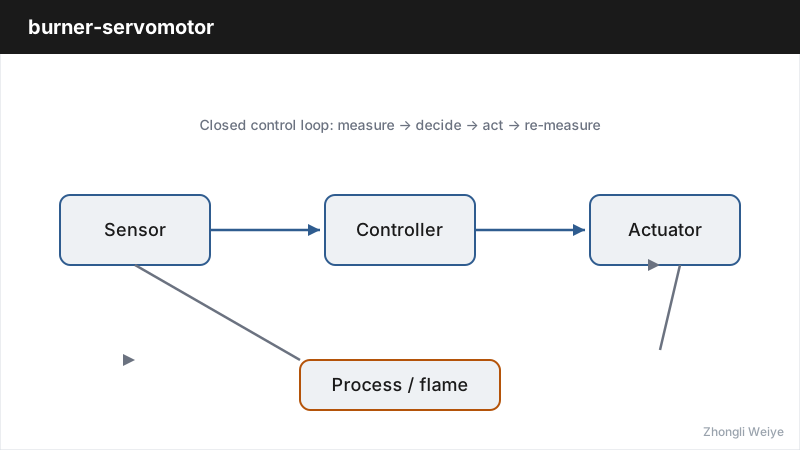
Position is the whole point
An on/off burner has two states and no interesting behaviour between them. A modulating burner asks for a number between them, and something has to put the fuel valve at exactly the opening that number corresponds to. That is the servomotor's job, and the quality of the whole control loop depends on whether it gets there.
The failure mode nobody plans for is not a motor that stops. It is a motor that arrives at a slightly different place each time under the same command. Nothing alarms, the flame still lights, and the burner runs for months producing a ratio nobody has measured since commissioning.
Calibration maps a signal to a physical opening
Between the control signal and the gas flow sits a chain: an electrical command, a motor, a gearbox, a linkage, and a valve with its own flow characteristic. Each element distorts the relationship. A valve's flow is not linear in its lift, a linkage introduces its own ratio, and a gearbox has friction that changes with direction and age.
Calibration is the process of measuring that whole chain and recording the correction, so the command the operator sends means what the burner actually does. A unit that has never been calibrated is not necessarily wrong, but nobody can say what it will do at seventy percent, because the number on the screen has never been tied to a flow.
Backlash is a dead band in the curve
Backlash is the slack in a linkage: the mechanism moves a little before the valve starts to respond. On a burner that reverses direction often, this shows as a curve that is different going up than coming down. The same command produces two different openings depending on which way the actuator last travelled.
It also produces a band of commands where nothing happens at all. Within that band the burner is holding whatever position it drifted to, and the controller is being told the load is satisfied. Backlash is why a burner can hold a temperature band all day and still show a rising oxygen reading, since the air and fuel are not moving together even though both are being commanded to.
Fuel and air actuators have to agree
On a burner where one actuator drives the fuel valve and another drives the air damper, the two are separate devices with separate calibration. They will not track each other by default. What holds the ratio across the range is not that both motors are running, but that both arrive at the openings the curve pairs at that point.
Where a single actuator drives both through a common shaft, the mechanical link guarantees the relationship, and that is stronger than two independent motors chasing each other. Where they are independent, the coordination lives entirely in the controller, and is only as good as the calibration underneath it.
Stroke speed is a safety parameter
How fast the actuator travels matters for more than response time. A damper actuator that moves slowly on a fault condition is allowing unburned gas to travel further than intended before it is shut. On shutdown, the closing speed is what limits how much fuel can pass after the safety circuit has called for it.
On the opening side, speed has a combustion consequence: a fuel valve that snaps open delivers a step change in firing rate, which the flame notices. Slow enough opening gives the air side time to respond. This is one reason a burner with fast actuators can smoke on start while a slower one does not.
Position feedback is what makes it verifiable
The useful part of a servomotor is not the motor, it is the feedback. A device that reports its own position can be checked against the command without opening the burner. A position that no longer matches what the controller believes is a fault you find on a display rather than in the flue.
When a modulation curve is tuned, that feedback is the instrument doing the work. Comparing commanded position against actual position across the range tells you whether the curve you drew is the curve the burner is following, and whether a change in the process load is being absorbed by the actuators or by the flame.
Frequently asked questions
What does a burner servomotor actually control?
It positions the fuel valve, the air damper, or both, in response to a command from the burner controller. Those positions determine the air/fuel ratio at each firing rate, which is why the actuator is treated as part of the combustion system rather than as a mechanical accessory.
Why does my burner run rich at low fire?
At low fire the two actuators are moving through the least positive part of their range, so small mechanical errors matter most. Backlash, a linkage that has loosened, or a valve that has never been calibrated will all show up as the air failing to keep pace with the fuel on the way down.
How do I know the servomotor needs service?
Watch for a flame that lags the control signal, a ratio that has drifted at part load without anyone changing anything, or visible slack in the linkage. A position reading that does not match its command is a more reliable indicator than any of these, because it is measured rather than inferred.
Can a servomotor be replaced without re-tuning the burner?
Not sensibly. A replacement has its own zero, its own span and its own direction of travel, none of which necessarily match the unit it replaces. Fit it, then verify the mapping between command and opening across the range before the burner returns to process duty.
What causes a servomotor to drift over time?
Worn gear teeth, a linkage that has loosened at its fixing, and a valve that has moved slightly in its seat all produce a slow change in the relationship between command and opening. It is rarely sudden, which is precisely why it goes unnoticed until a flue gas reading confirms what the linkage has been saying for months.
Does a faster servomotor improve burner performance?
Not on its own. Closing speed is a safety consideration and opening speed affects how gently the flame is introduced, but neither changes where the mechanism ends up. A fast actuator with a sloppy mechanism arrives faster and less reliably than a slow one that lands in the same place every time.
Request a quote
Send the burner model and the actuator part number from its plate, and we can confirm whether a replacement is a like-for-like swap or whether the linkage and calibration need attention at the same time. If you are chasing a part-load drift, the model plate plus your flue readings usually identifies the actuator faster than guessing does.
Related products
The parts and product families referenced in this guide:
- modulating actuator with position feedback
- air side travel to match the fuel curve
- drawing the curve across the range
- Siemens SQM45 modulating actuator
This guide covers Burner Servomotor: The Actuator That Sets the Fuel Curve. For the exact part that fits your duty, send us the model plate photo and we confirm availability, lead time and a matched quotation.