
An industrial heating burner is not a single product but a family of devices, and the jobs they are matched to could hardly be more different. A 90 deg;C hot-water loop, a 600 deg;C aluminium ageing oven and a 1250 deg;C steel reheating furnace each need a different burner. The most common mistake is buying the highest-output unit available instead of the one whose firing characteristics fit the process. This guide sets out the order plant engineers work in: fix the temperature band, choose how heat reaches the product, size for the real load swing, then narrow by fuel, emissions and atmosphere.
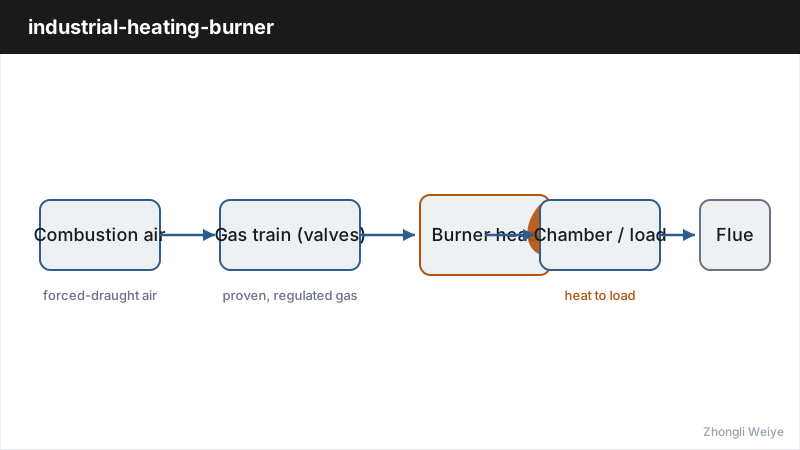
The temperature band narrows the field faster than anything else
The operating temperature band is the fastest way to cut a shortlist, because it decides flame temperature, chamber materials and whether you can fire straight into the load. Loops below roughly 250 deg;C want gentle, fully modulating heat from gas or oil burners with soft flames and good turndown at the bottom. The 250 to 800 deg;C band covers ovens, dryers and ageing furnaces, where premix or high-velocity firing drives convective transfer across the gas volume. Above 900 deg;C you are into forging and reheating territory, where velocity and turndown matter more and the air is often preheated through regenerative or recuperated systems.
Set the band before anything else and whole families rule themselves out. A burner sold for a 200 deg;C duty will not survive a 1000 deg;C chamber, and a high-velocity unit designed for a forging furnace is an expensive way to heat a hot-water loop. The band also fixes your refractory and insulation budget, so a burner chosen in isolation from it tends to arrive with the chamber already committed to the wrong assumption.
Direct or indirect firing: how the heat reaches the product
Direct-fired burners put flame and hot combustion gas into the chamber with the load. That is simple and efficient, but the product sits in the combustion products, which matters when coatings are sensitive, food contact surfaces are involved or the process needs a reducing atmosphere. Indirect-fired arrangements, whether a radiant tube or a separated combustion chamber, keep the flame and the fumes away from the product and let only clean hot gas or radiant energy reach it. Radiant-tube burner arrangements remain the standard indirect choice for atmosphere furnaces.
Where the product is thin, flat or moving through a line, there is a third option worth evaluating. Infrared heating puts energy onto the surface directly instead of warming a whole volume of air, which shortens soak time considerably when only the surface needs to reach temperature. It is less forgiving than convective firing, since surface temperature rises faster than the air around it, so product spacing and control resolution matter more. Choose the firing mode from the contamination risk and from how heat actually has to reach the material, not from what the plant already has.
Turndown has to cover the real load swing
Turndown is the ratio of maximum to minimum stable firing rate, and it is where a lot of burners are specified wrongly. A steady baseload and a swinging batch load are different problems. If the burner's stable low end sits above the process minimum, the controller has no choice but to cycle the burner fully off and on again, which wastes fuel, cycles the igniter and shocks the refractory lining. Sizing to the measured swing rather than the nameplate peak removes that behaviour.
Read the turndown from a firing curve rather than a headline figure, because the ratio quoted in a brochure is often measured at conditions you do not have. The turndown-ratio guide shows how to locate the band where combustion genuinely stays stable, which is narrower than the mechanical range. As a rough guide, batch processes with wide swings frequently need something in the order of 10:1 or better, while steady continuous lines often run comfortably at 3:1 to 5:1. Treat those as typical ranges rather than specifications, and confirm against your own load profile.
Fuel, emissions limit and atmosphere decide the rest
Fuel availability and the local NOx limit shrink the shortlist more than any brochure does. Natural gas, light oil, heavy oil and dual fuel each impose a different burner architecture, and the gas against oil comparison sets out the trade-offs in service life, storage and emissions. Where air-quality rules are tight, a low-NOx head or flue gas recirculation stops being an option and becomes a requirement, which on its own can eliminate several otherwise suitable burners.
Atmosphere is the other constraint people leave until commissioning. A process that needs oxidising, reducing or inert conditions cannot share a burner with one that does not, because sealing and purge arrangements differ completely. Dual-fuel flexibility also protects uptime where one fuel gets interrupted or repriced, which is why plants spec dual-fuel burners on critical continuous lines and single-fuel units everywhere else.
Serviceability decides the last few percent
A burner you cannot service quickly is a production stop waiting to happen. Favour units built from common, locally stocked parts: standard gas-train fittings, off-the-shelf ignition transformers and widely available burner program controllers. Check the availability of wear items before you buy. A worn electrode or a failed solenoid valve should be a same-day fix, not a two-week import, and the maintenance checklist is worth reading before you commit to a platform.
Pulling it together as a short list you can hand any supplier: (1) process temperature band and target product temperature; (2) firing mode, direct, indirect or radiant; (3) measured load swing and the turndown needed to cover it; (4) fuel or fuels and the local NOx limit; (5) atmosphere, oxidising, reducing or inert; (6) spare-parts availability on wear items. Suppliers who answer all six with numbers rather than adjectives are the ones worth a second conversation.
Frequently asked questions
How do I choose between a direct-fired and an indirect-fired burner? Choose direct firing when efficiency and simplicity matter and the product can tolerate contact with combustion products. Choose indirect, radiant tube or separated combustion when the load is sensitive to fumes, needs a controlled atmosphere or must avoid contamination. Coatings, food contact and reactive metals are the usual cases.
What turndown ratio does an industrial burner need? It depends on the measured load swing rather than on any catalogue default. Batch processes with wide variation often need 10:1 or higher, while steady continuous lines frequently run at 3:1 to 5:1. The number that matters is the stable combustion band on the firing curve, which is narrower than the mechanical range quoted in most brochures.
Is a dual-fuel burner worth the extra cost? For critical or continuous lines, usually yes, because dual fuel lets the plant keep firing when one supply is interrupted or repriced. For intermittent, non-critical heating the added valving and control complexity rarely earns its cost, so single-fuel is the sensible default there.
Which emissions rule actually drives burner choice? The local NOx limit is usually the decisive one. Where limits are strict, low-NOx burner heads or flue gas recirculation move from optional to mandatory, and that constraint alone removes several otherwise suitable models from consideration before any other criterion is applied.
Why does spare-parts availability matter as much as performance? Because a burner that cannot be repaired quickly becomes a production bottleneck. Standard, locally stocked components turn an unplanned shutdown into a same-day repair, whereas proprietary or long-lead parts turn the same event into a multi-week outage on an entire line.
Does the process temperature alone determine the burner? No, it is only the first filter. Temperature sets flame design and materials, but the firing mode, load swing, fuel, emissions limit and atmosphere each remove further options, and serviceability usually settles the final choice between the units that survive all of those.
Request a quote
Send the temperature band, fuel, atmosphere and measured load swing, and we will point you to the burner family that fits before you commit to a single model. If a burner is already installed and not performing as specified, add the fuel, the existing turndown and where in its range the problem appears, since those three details usually narrow the cause quickly.
Related products
The burner families and control parts this selection process usually ends up involving:
- gas burner range
- fuel oil burner range
- dual fuel burner
- burner program controller
- gas train solenoid valve
This guide covers Industrial Heating Burner: Match the Burner to the Process, Not the Output. For the exact part that fits your duty, send us the model plate photo and we confirm availability, lead time and a matched quotation.