
Nitrogen oxide in a burner flame is not a design flaw that better engineering would have removed. It is the arithmetic consequence of hot nitrogen meeting oxygen, and every technique marketed as low-NOx combustion is a way of making that meeting less favourable.
Two formation routes, two different problems
Thermal nitrogen oxide is the dominant route in most industrial flames. Nitrogen from the air and from the fuel reacts with oxygen at high temperature, and the rate climbs steeply with every increment of flame temperature. Peak temperature, not average temperature, governs it, which is why a flame that looks uniform can still be producing a great deal of it in one small region.
Fuel nitrogen is a separate route and behaves differently. Nitrogen already bound into the fuel does not need heat to become nitrogen oxide, it needs oxygen. Cutting fuel nitrogen is therefore a fuel quality question rather than a burner question.
Staged combustion works by lowering the peak
If peak temperature drives thermal nitrogen oxide, the direct approach is to stop having a high peak. Staging does this by withholding part of the combustion air until later in the burn, so the initial reaction happens with less oxygen available and a lower flame temperature, and the remaining air is admitted once the main combustion zone is established.
Staging fuel rather than air is a variation on the same idea, used where a head cannot readily delay its air. Which one a design uses comes down to the head geometry and the fuel. The two do not behave identically at low fire, and a design that performs well at full output can behave quite differently as the air rate falls.
Premixing moves the problem rather than removing it
In a premixed burner, fuel and most of the air are mixed before they enter the flame, and the flame becomes the reaction front of that mixture rather than a diffusion flame. Because the mixture is lean, the flame temperature is lower and the reaction is spread over a larger volume, so the peak falls and nitrogen oxide with it. Premixed burner design is built around that trade.
What premixing costs is stability margin. A lean premixed flame has less room to move before it lifts off or flashes back, and the usable range of ratios becomes narrower. This is why a premixed head is a matched assembly rather than a component: the mixing geometry, the swirl and the flame arrestor all have to belong to the same design for that narrow window to be usable in the field.
Flue gas recirculation cools without diluting the reaction
Returning a portion of the exhaust to the burner inlet lowers the temperature of the incoming mixture, and therefore the flame temperature, without changing the stoichiometry of the reaction. Because the recirculated gas is largely inert, it acts as a heat sink rather than as extra oxygen.
The cost is a fan, ducting and the pressure to push it. Internal recirculation, using the furnace's own exhaust through ducting around the chamber, is cheaper to run and harder to control because the flow depends on furnace conditions. External recirculation with a dedicated fan is more controllable and consumes more power. The air side arrangement decides which is practical.
The carbon monoxide side of the same trade
Every technique that lowers flame temperature does so by accepting a slower or less complete reaction at the peak. If the process is not given enough time or oxygen to finish, the result is unburned carbon leaving as carbon monoxide, along with soot. A burner adjusted aggressively for nitrogen oxide and then found to be producing carbon monoxide has not improved anything; it has moved the problem into a metric that is usually regulated more tightly.
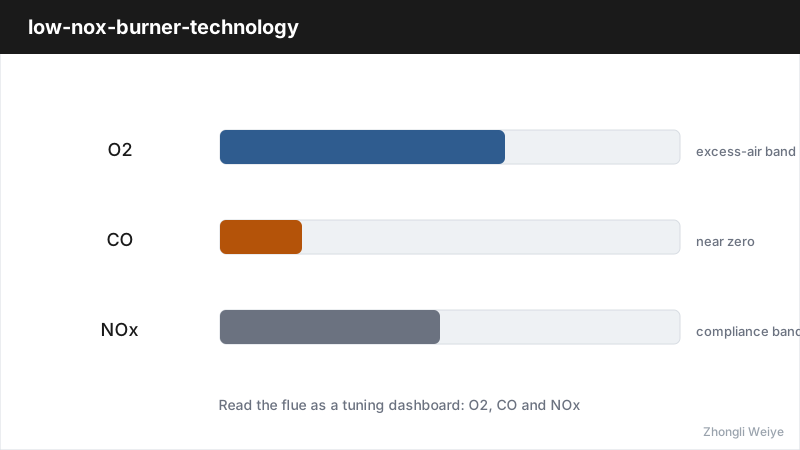
This is why the two are measured together. A ratio lean enough to bring nitrogen oxide down is easy to reach by moving the damper, and equally easy to reach by starving the flame. The difference is visible in the carbon monoxide reading, which is why both belong on the same sheet.
Verification on the actual duty is not optional
A burner that meets a limit under test conditions tells you very little about the installation. Chamber geometry, draught conditions, fuel analysis and load all move the result, and the appliance can recirculate its own exhaust back onto the flame in ways the burner design never anticipated.
What flue gas analysis on site establishes is whether the combination achieves what was specified at the loads the process will really see. The measurement has to be taken at a representative point in the range, because a burner tuned at full output has not been tuned at the low end, where the flame is smallest and nitrogen oxide per unit of heat is often highest.
Frequently asked questions
How do low-NOx burners actually reduce emissions?
They lower the peak flame temperature and reduce the oxygen available at the hottest point, which is where thermal nitrogen oxide forms. Staged air or fuel, lean premixing and flue gas recirculation are the three common routes, differing mainly in how the heat release is distributed through the flame.
Does low-NOx combustion cost efficiency?
It can, but not inevitably. Well-designed staging and premixing keep the reaction complete, so the loss is small. Poorly executed tuning trades nitrogen oxide for unburned carbon, and that is where the efficiency penalty appears, because the flue gas then carries away chemical energy as well as heat.
Can an existing burner be converted to low-NOx operation?
Sometimes, through a different burner head, a recirculation kit or a change of fuel, and sometimes not at all. The chamber matters as much as the burner, and any conversion has to be re-commissioned and re-measured on site. A label on the head is not evidence the appliance meets a limit.
Why is nitrogen oxide often worse at low fire?
At low fire the flame is smaller and the same nitrogen passes through less volume, so the concentration per unit of heat can rise even as the absolute output falls. A burner that measures well at full output still needs checking at the low end.
What is the difference between thermal and fuel nitrogen oxide?
Thermal nitrogen comes from nitrogen in the air reacting at high temperature, and burner design reduces it by lowering the peak. Fuel nitrogen comes from nitrogen already in the fuel combining with oxygen, and that portion responds to fuel analysis and combustion completeness rather than flame temperature.
How is a low-NOx burner verified before handover?
By measurement on the installation, at representative loads, with both nitrogen oxide and carbon monoxide recorded. A flame is only proven by what leaves the stack, and the same burner in a different chamber can give a different result.
Request a quote
If you have a chamber, a fuel and a limit to work against, send them over. The limit alone does not determine the burner, because the appliance geometry and the fuel analysis usually do more to the achievable result than the head does. If you have measurements showing where you stand, attach those.
Related products
The parts and product families referenced in this guide:
- low NOx oil burner
- reading NOx against CO on site
- delaying the air for a staged profile
- sampling the flue where the gas is real
This guide covers Low-NOx Burner Technology: How Flame Staging Cuts Emissions. For the exact part that fits your duty, send us the model plate photo and we confirm availability, lead time and a matched quotation.