
A premix burner mixes fuel with most of the combustion air before the mixture reaches the flame, so the reaction happens along the whole length of the burner head instead of at a single sharp front. That single change is the whole argument for the design. A diffusion flame has a recognisable hot core with a definite temperature peak, and it is that peak, not the total heat release, that produces most of the nitrogen oxides. Premix trades the peak for a longer, cooler, more even burn, and the emissions follow.
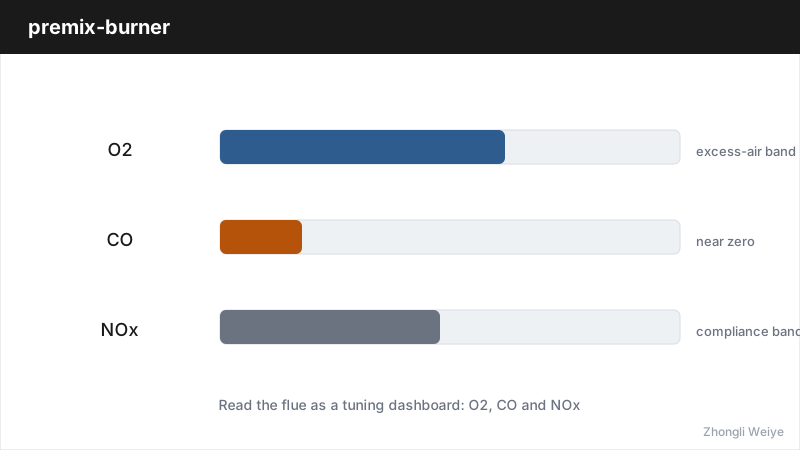
NOx is a temperature problem before it is a volume problem
Thermal NOx, which is usually the dominant source in a gas-fired furnace, forms when nitrogen from the air and oxygen from the combustion process are held at high temperature for long enough to react. The rate climbs steeply with temperature, which is why a flame that peaks very hot produces far more of it than two flames releasing the same total heat at a lower peak. Premixing attacks that peak directly. Air and fuel are combined in the mixer and in the burner ports before ignition, so ignition happens along a distributed front rather than at one point, the flame is longer, and the peak sits lower even though the burner is delivering the same firing rate.
The practical consequence is that premix is usually specified against an emission limit rather than against a preference. If a site has a hard cap on NOx output, the question is rarely which burner is most efficient but which one can meet the number at the lowest firing rate the process actually runs at, because that is where premix designs are under most strain. Our article on burner emissions and NOx measurement covers how the limit should be established before the burner is chosen.
The stability window is the price of the clean flame
Premixing removes the flame's natural separation between fuel and air, and with it goes the wide forgiving band a diffusion flame enjoys. The flame now has two failure modes and it sits in a narrow corridor between them. If the mixture velocity through the ports drops too low, the flame can travel backwards into the mixer and ignite the fuel-air mixture upstream of the burner head, which is a flashback and it can melt the hardware. If velocity rises too high, the flame lifts off the port and blows out. The band between those two limits is the stability window, and its position is set by the port geometry, the mixture velocity and the fuel.
What makes this a specification problem rather than a fitting problem is that the window moves. It shifts with fuel pressure, with gas composition, with altitude, and with how clean the air is. A burner that runs comfortably in the middle of its window on natural gas can sit much closer to the flashback limit on a gas of different density, and a burner commissioned once and then left alone gradually drifts out of specification as the installation changes around it. Our article on air-fuel ratio tuning covers the trim that keeps it centred.
Commissioning is where the datasheet numbers are won or lost
The emissions figures published for a premix burner assume a correctly set up burner. That means the mixer supplied with the burner matched to the gas pressure actually available, the combustion air at its designed temperature and quantity, the ignition electrode positioned as the manufacturer specified, and the total air-fuel ratio inside the narrow band the design tolerates. None of that happens by default. An undersized gas supply or a dirty air filter pushes the ratio out, and the first symptom is usually not an alarm but poor emissions and a flame that looks acceptable at full fire and misbehaves as it is turned down.
It is worth putting the premix commissioning sequence on the same footing as a safety commissioning, because the failure modes are energetic rather than cosmetic. Purge before ignition, prove the gas pressure before opening the valve, verify air supply before the fuel valve is permitted to open, and confirm flame proving before releasing the fuel. A burner program controller sequences this and will refuse to proceed when a proving switch is open, which removes most of the ways a premix installation hurts itself. The burner commissioning checklist sets out the full sequence, and flue gas analysis is how you confirm the result rather than assuming it.
Turndown is the constraint that decides real-world fit
Published turndown figures are quoted with the stability window in mind, so a premix burner rated for a wide turndown can genuinely hold a low load inside its window. What the rating does not tell you is whether it also meets the emission limit at the bottom of that range, and the two are different questions. As the firing rate falls, the flame becomes shorter and less well mixed, peak temperature rises relative to the mean, and the margin against the NOx limit narrows. A burner that comfortably passes at full fire may sit near the limit during a long low-load soak, which is exactly the condition that lasts all night.
Where the process genuinely swings that hard, staged or modulated firing spreads the problem out rather than solving it. Firing one burner of two at full load is usually cleaner than holding both at half, because each premix flame stays nearer the centre of its own stability window. A servo motor on the fuel valve combined with a damper actuator on the combustion air gives the control resolution to hold the ratio across the range. Our article on burner turndown ratio covers how to read the number rather than take it on trust.
Where premix is the wrong answer
There are three cases where the wider stability window of a conventional burner is worth more than the emissions gain, and specifying premix into any of them creates problems that show up as downtime. The first is dirty or dust-laden combustion air, where the mixer is the component most likely to foul and a fouled mixer means the ratio the burner thinks it is running is no longer the ratio it is running. The second is very low load or long soak periods below the point where the flame stays clean. The third is a fuel that changes, since a premix burner tuned for one gas is not automatically correct for another and the mixer is the part that has to change.
Premix is also a gas technique in a way that matters. Liquid fuel has to be atomised and vaporised before it can premix, which is a different problem solved with different hardware, so an oil-fired duty that needs low NOx generally reaches it through staged diffusion, flue-gas treatment or a different combustion principle rather than through true premixing. Where the fuel is not fixed, the burner choice and the fuel choice are one decision rather than two. Our article on gas, oil and dual fuel selection covers that, and low NOx burner technology sets out premix against the alternatives.
Safety chain and supervision on a premix burner
The safety components are largely the same as on any gas burner, but the premix geometry changes how careful the proofing has to be. Flame supervision has to be positioned where it sees the distributed premix flame reliably rather than the point of highest intensity, and the fuel and air proving has to be arranged so the burner cannot open the fuel valve into an unproved air supply, since it is the air side that keeps the flame off the flashover boundary. A flame detector chosen for the burner head rather than for the class of burner, and an air pressure switch in the air proving line, are the two parts that matter most here.
Our article on burner safety interlocks covers the full chain, and flame detection covers the supervision detail. The point to carry away is that a premix burner is not a more dangerous appliance than a diffusion burner, but it is a more precisely tuned one, and the components that make it safe are the same components asked to hold a tighter tolerance.
Frequently asked questions
How does premixing actually reduce NOx? By mixing fuel and air before ignition, the reaction is spread along a longer flame at a lower peak temperature. Thermal NOx formation rises steeply with temperature, so replacing a sharp hot diffusion front with a cooler distributed flame produces significantly less of it at the same firing rate.
What is the main failure mode of a premix burner? Flashback at low mixture velocity and blowout at high velocity. The burner port geometry sets the safe band between them, and air-fuel ratio errors or blocked mixing ports push the flame out of it. Both are avoided by keeping the commissioned mixture velocity inside the band across the whole firing range.
Will a premix burner still meet its emission limit at low load? Not necessarily. As firing rate falls the flame shortens and peak temperature rises relative to the mean, so the margin against the NOx limit narrows exactly where the burner is least robust. Check the emission figures at the lowest load the process will hold, not only at full fire, and consider staging if the margin is thin.
Can a premix burner fire liquid fuel? Premix is fundamentally a gas technique. Liquid fuel must be atomised and vaporised first, so low-NOx oil duties normally rely on staged diffusion or flue-gas treatment instead. Where the fuel can change, treat burner selection and fuel selection as one decision.
How often does a premix burner need servicing? The mixer is the component to watch, because it is the part that determines the ratio the burner actually runs. Inspection intervals should come from the air quality at the site rather than from a fixed calendar, since fouling depends on what the combustion air carries. Fins, filters and the mixer should be checked together.
Does premix need a different safety chain? The components are the same class as a conventional gas burner, but flame supervision must be positioned to see the distributed premix flame reliably, and air proving must be arranged so fuel cannot be released into an unproved air supply. A flame detector matched to the burner head matters more than usual here.
Request a quote
If an emission limit is driving your burner choice, tell us the fuel, the load profile including the lowest sustained load, and the target figure. We will size a premix or staged arrangement with the control it needs, and flag the turndown where the clean window starts to close.
Related products
The parts and product families referenced in this guide:
- Premix and low-NOx burner models
- Controller enforcing purge and proving before fuel
- Flame detector positioned for a distributed premix flame
- Servo motor resolving modulation across a narrow window
- Air proving switch protecting the premix boundary
This guide covers premix burner technology. For the exact part that fits your duty, send us the model plate photo and we confirm availability, lead time and a matched quotation.