
Oxides of nitrogen and carbon monoxide sit on opposite sides of the same combustion trade-off. Lowering flame temperature reduces one and pushes the other up, so the useful question is where the appliance should sit and how it is held there.
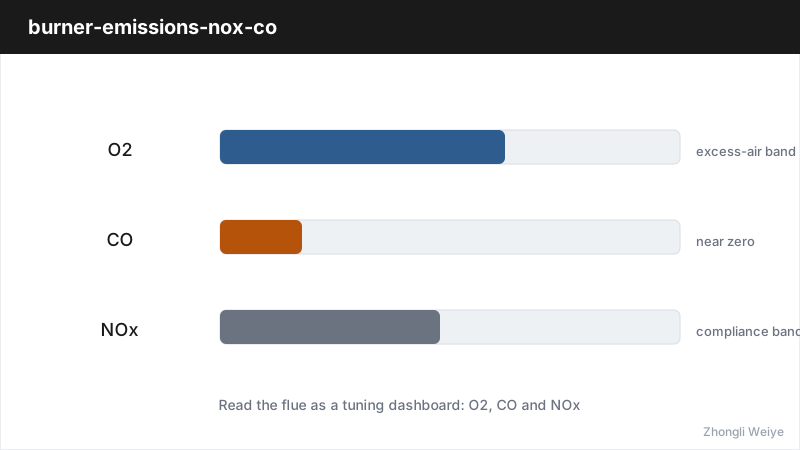
Where nitrogen oxides come from
The dominant mechanism at burner temperatures is thermal: nitrogen from the air combines with oxygen at high temperature, and the rate rises steeply with flame temperature. That is why a design aimed at lower emissions concentrates on controlling peak temperature. The flame has no single temperature: there is a peak near the burner port and a longer tail downstream, and the peak produces the nitrogen oxides.
A second mechanism matters on liquid fuels, where a small part of the fuel nitrogen can appear in the flue without any air nitrogen being involved. It is usually the smaller contribution, but it means a fuel change can move the reading even when nothing about the appliance has changed. Worth knowing before a fuel switch is written up as a burner fault.
Carbon monoxide means the mixture is locally rich
Carbon monoxide forms where there is fuel and not enough oxygen to burn it completely. It is a mixing and air distribution signal rather than a temperature one, and it appears where the air and fuel streams fail to interpenetrate. A burner can show a good average oxygen reading and still produce measurable carbon monoxide at the flame root, because the analyser sees a mixed sample and the root is where the mixture is richest.
The consequence is that the two often move in opposite directions, which is why treating them as one adjustment is a mistake. Raising the air to lower nitrogen oxides raises the carbon monoxide. The flue gas analysis notes cover where the probe has to sit for either reading to be worth acting on.
Why the trade-off is real
Lowering flame temperature is the most direct route to lower nitrogen oxides, and two methods are common. Staging the air splits the combustion air so the flame is longer and cooler through its length, at the cost of a less intense flame root. Diluting the air with flue gas does the same more compactly, and changes the air path and the control problem with it. Both trade flame intensity for temperature.
The trade becomes uncomfortable at the low end of a range, because a flame already long and cool at full fire may not stay stable when the flow drops further. Appliances designed for low emissions therefore often give up some turndown. Our gas burner range covers the platforms where that choice is made at specification rather than after a failed test.
What low emissions design costs in practice
Staged air needs a second damper and actuator, which means more to fail and more to calibrate. Flue gas recirculation needs a duct, a fan and a damper in a hot gas path, a maintenance environment rather than a benign one. Neither is expensive relative to the appliance, but both add commissioning work, because the air split has to be set and held across the range.
Combustion stability is the other cost. A longer, cooler flame is more vulnerable to the disturbance a compact flame shrugs off, which shows up as flame failure during warm-up or a fast load change. Where the process cannot tolerate that, a design meeting the emissions requirement may still be the wrong appliance, and that judgement belongs before ordering.
What representative conditions actually mean
A reading taken at commissioning, on a cold appliance at one firing rate, says little about what the installation will do across a year. Flame temperature and therefore nitrogen oxides move with inlet air conditions, so a comfortable setting in one season may not be in another. The air and fuel ratio notes cover rechecking the ratio when conditions shift.
Obligations are assessed against the limits applying in the jurisdiction where the appliance operates, and those differ by application and by fuel. Confirm what applies before commissioning, and record the readings with the instrument identity, its calibration and the sampling position, because a number without those conditions cannot be defended later. Our commissioning checklist sets out where those readings belong.
Frequently asked questions
What causes most of the nitrogen oxides from a burner?
At burner temperatures the dominant route is thermal, where nitrogen from the air combines with oxygen near the high-temperature flame root. A smaller contribution on liquid fuels comes from nitrogen in the fuel itself. That is why emission control measures concentrate on flame temperature and on delaying where fuel and air first meet.
Why does lowering nitrogen oxides increase carbon monoxide?
They respond to the same change in opposite directions. The adjustments that cool a flame lengthen it, and a longer flame relies more heavily on air mixing to stay complete. Where mixing is imperfect at the flame root, carbon monoxide appears. Both readings have to be taken together, and a tuning change is not an improvement until both are rechecked.
Can a burner be tuned to meet low emission limits and still run its full turndown?
Sometimes, and often not. Flame length and temperature increase with low emission measures, and a long cool flame at full fire may not stay stable when the flow drops further. Appliances designed for low emissions commonly give up some turndown. Where deep modulation is required, the design has to balance the two rather than assume both are available.
Does the fuel type change the emissions readings on the same burner?
Yes, and the reason differs between the two. Carbon monoxide is an atomisation matter as well as a mixing one, and a switch to liquid fuel introduces a fuel nitrogen contribution a gas flame does not have. Any fuel change should be followed by fresh readings rather than an assumption that the previous tuning holds.
How often should emissions be measured on a running installation?
At commissioning, after any change to the fuel path, air path or control settings, then on a schedule tied to how much the readings are relied upon. A continuously fired plant benefits from readings at more than one firing rate and in more than one season. Record the instrument, its calibration and the sampling position so the readings stay comparable.
What can be done when an existing burner does not meet the required limits?
Start with the measurement, because a sampling position or instrument problem sends the investigation the wrong way. Then check what moves the readings cheaply: the ratio across the range, the air path condition, and the settings at the low end where the flame is weakest. If the design is the constraint, the options are a low emission burner or a change of fuel, both appliance decisions.
Request a quote
Zhongli Weiye supplies gas and liquid fuel appliances, the air path components and the control platforms used to hold a setting across a range, and matches replacement parts to the appliance installed. Send the burner model, the fuel, the application and the limits applying at the site, and the recommendation comes back with the parts that fit.
Related products
The parts and product families referenced in this guide:
- low emission flame shaping
- staged air damper arrangement
- emissions analyser commissioning
- emission reading at part load
This guide covers Burner Emissions: Reading NOx and CO as a Tuning Signal. For the exact part that fits your duty, send us the model plate photo and we confirm availability, lead time and a matched quotation.