
A radiant tube burner fires into a sealed tube and heats the tube wall, not the workpiece. The tube reaches temperature, radiates across the gap to the charge, and passes the combustion gases to the far end without ever exposing the product to them. Where an open flame would deposit soot, scale or combustion products onto the work, the tube walls that in between. That is the entire argument for the design, and it is why it survives in processes where the surface finish or the atmosphere is the product rather than merely the temperature.
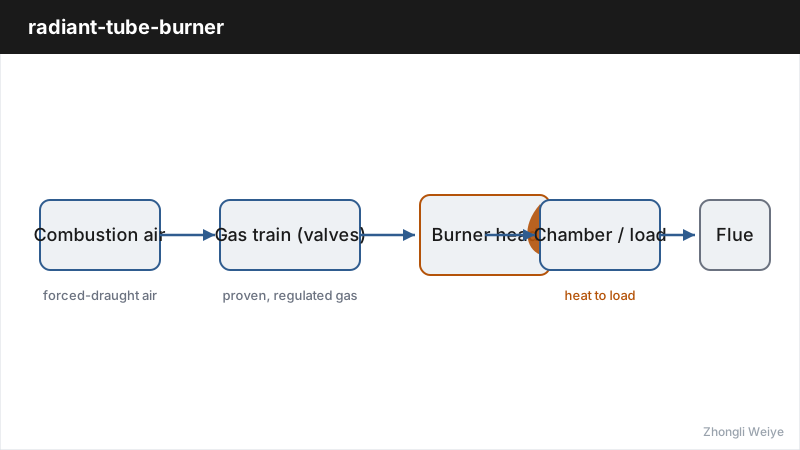
What the sealed tube actually buys
For coatings, food contact, sintering and any atmosphere that has to stay inert or clean, the exhaust is the problem. An open flame in the same chamber puts combustion products into contact with the work, and on a surface that is going to be finished or eaten or bonded that contact is unacceptable. Sealing the flame inside a tube removes the path entirely. There is no longer a leak route between flue gas and product, so there is nothing to deposit and nothing to react with the load.
The trade is that the tube becomes a hot pressure part inside the furnace, and it has to be treated as a pressure component rather than a piece of furnace furniture. That single shift changes how the furnace is designed, maintained and inspected, which is the part of the decision that is easy to underestimate before specifying it and expensive to discover afterwards.
Radiation gives even heat without impingement
Heat reaches the load by line of sight from the tube wall, so the load does not have to sit in a stream of hot combustion gas or in the turbulent wake of a flame. A well laid-out tube bank produces a smooth flux across the chamber, without the local impingement an open flame creates where the gas is fastest. For thin sections, coated parts and anything that scorches easily, that evenness is frequently the entire reason for specifying the arrangement, because a flame that licks one spot will mark it every time.
This is also the case where a tube burns cleanly and needs little gas-side air, which suits processes with a controlled atmosphere. Keeping combustion separated from the chamber means the atmosphere in the work zone is set by the process rather than diluted by exhaust. Our article on infrared burners covers the other way of reaching the same outcome with a radiant surface at short range, which is worth comparing when the chamber is small.
Where it beats an open flame, and where it does not
The duties that gain most are the ones where the load must not meet combustion products: annealing lines, enamel and paint curing, carburising and other controlled-atmosphere heat treatment, and drying in food and pharmaceutical processing. In each of those the surface or the atmosphere is the deliverable, so the separation the tube provides is the product rather than a refinement of it. Where atmosphere control matters, the design also avoids diluting the chamber atmosphere with exhaust.
An open flame in a clean forge or a furnace with a steady load and no surface requirement can be simpler and cheaper, and there is no reason to pay for a tube arrangement. The test is whether anything about the work would be damaged by combustion products reaching it. If nothing would be, the tube is buying an atmosphere you do not need.
The tube is the weak point, and it is a pressure part
The tube sees the full flame temperature on the inside and the furnace atmosphere on the outside, and it lives or dies on its material, its wall thickness and how it is supported. High nickel alloys, normally centrifugally cast, carry the highest temperature range and cost accordingly. Welded sheet or cast tubes suit lower-temperature zones, weigh less and give up temperature headroom. Matching the alloy to the hottest point the tube will actually see, including soak during shutdown, is the specification decision that determines uptime.
Support and expansion allowance deserve more attention than they usually get. A tube that cannot expand freely develops stress at the supports, and a tube with an unsupported long span distorts enough to bring the hot surface close to the chamber wall, which is how a tube eventually fails. When one does fail it vents exhaust into the chamber, and the separation the design exists to provide is lost along with the product in the chamber. Our article on burner maintenance planning covers the inspection intervals that make the difference.
Heat recovery comes built in
A radiant tube already has hot exhaust leaving one end, so a recuperator is a natural addition rather than an accessory. The exhaust preheats the combustion air before it reaches the burner, which lifts efficiency without ever exposing the product to the flue, and it can be arranged as self-recuperation in single-ended designs where the burner and the air preheater sit at the same cold end. That layout means recovery and radiation are designed as one package instead of two bolt-ons competing for space.
The recovery side has its own discipline. Because the flame is on the same side as the preheated air, the tube wall sees the flame temperature directly, and a recuperated arrangement leaves less margin for the tube alloy than an unrecovered one. On higher-temperature work the choice is between pushing the furnace harder and accepting the extra stress on the tube wall. Our article on heat recovery burners covers the arrangements, and combustion air covers what happens when that air is hot.
Sizing and layout decide whether the radiation is even
Tube diameter, wall thickness, spacing and orientation set both the uniformity across the chamber and how long the tube lasts. Tubes too close to the load recreate the local impingement the arrangement was chosen to avoid, and tubes too far apart leave the corners cold and the flux uneven. The two failure directions pull in opposite directions, which is why a layout study is worth more than a catalogue drawing copied into a drawing office.
Non-standard load shapes make that harder still, because a layout designed around a rectangular envelope is wrong the moment the workpiece tapers, steps or sits at a different height. Standard furnace layouts published by suppliers assume the load sits where it was drawn. Where it does not, the zones nearest the tube ends run hotter than the middle, and the uniformity the tube was specified for does not arrive. On a furnace with an irregular load it is worth designing the tube field against the load rather than against the chamber.
Frequently asked questions
What tube material should be specified? It follows the tube-wall temperature rather than the furnace setpoint, and the hottest point the tube will see, including soak during shutdown. High nickel alloys, usually centrifugally cast, cover the upper range; welded sheet or lighter cast alloys suit cooler zones and save weight. A realistic temperature margin is worth more than extra wall thickness.
Single-ended or double-ended tube? Double-ended straight tubes need access at both ends and give simple flow. Single-ended U-tubes put the burner and the exhaust at one end, which suits self-recuperation and a furnace wall with limited access. The choice is mostly about furnace geometry and how you intend to recover heat.
How does a radiant tube compare with an infrared burner? Both keep combustion products off the product. A tube radiates across a larger gap from a hot metal surface and suits bigger chambers and higher uniform-temperature duties. An infrared emitter radiates at shorter wavelength and closer range, which wins on speed for thin surfaces. Our article on infrared heating applications covers that comparison in more detail.
Can heat recovery be added to a radiant tube? Yes, and it is common. The tube exhaust is already hot and available, so a recuperator preheats the combustion air without exposing the product to the flue. On single-ended designs it can be arranged as self-recuperation with the burner and preheater at the same cold end, so recovery and radiation become one package.
What actually ends tube life in practice? Sustained over-temperature, repeated thermal cycling that fatigues the weld or the cast structure, and contamination from the load or the atmosphere. Support design and expansion allowance matter at least as much as wall thickness, and a failed tube vents into the chamber, so the separation the design exists for is lost along with the product.
Do radiant tube burners need a full safety chain? Yes. Flame supervision, proof of fuel and air pressure and a proven shut-off apply as they do to any fired burner. Because the flame sits inside the tube, the supervision has to see the flame where it actually burns, and the air proving has to be arranged so fuel cannot be released into an unproved air supply.
Request a quote
If you are specifying a furnace where the surface or the atmosphere cannot be allowed to meet the exhaust, send us the chamber size, the load shape, the target temperature band and the process atmosphere. We will point to the tube arrangement and the recovery option that fit before you commit to a tube material.
Related products
The parts and product families referenced in this guide:
- Burner sizes matched to tube furnace duty
- Controller sequencing a recuperated tube burner
- Flame detector proving the flame inside the tube
- Gas shut-off valves for the tube burner train
- Pressure switches proving fuel and air
This guide covers radiant tube burner design. For the exact part that fits your duty, send us the model plate photo and we confirm availability, lead time and a matched quotation.