
A burner performs only as well as the chamber it sits in. The chamber decides how much volume the flame has to develop in, how long the gas stays at temperature, where the hot gas goes, and whether the flame is allowed to develop or is aimed at something that will crack. Most chamber problems are discovered as refractory damage and are then blamed on the burner.
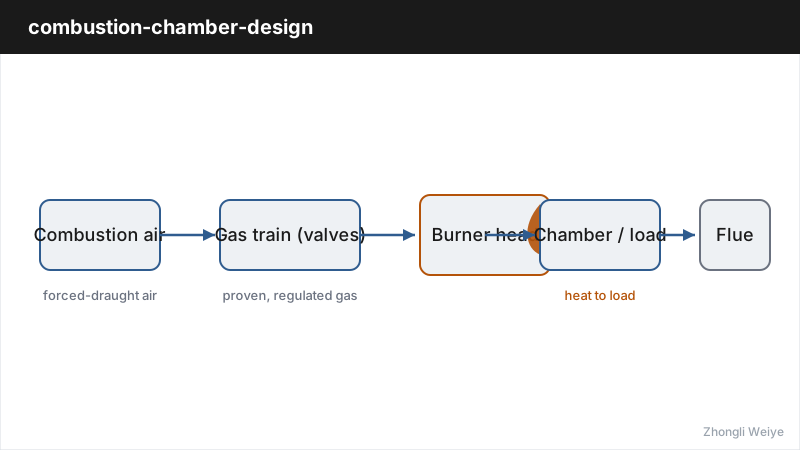
Volume sets how long combustion has to finish
The chamber has to hold the flame and keep the products of combustion at temperature long enough for the reaction to complete. Under-volume means the flame has nowhere to develop and the flame length exceeds the space available, so it impinges or lifts off the burner. Too large a chamber is a different failure with a similar signature: the gas spends so long in the chamber that it gives up more heat to the walls than the process receives.
Volume therefore links to firing rate in a way that is easy to get wrong. Raising burner output without increasing chamber volume shortens the residence time at the same time as it lengthens the flame, so the burner gets less chamber as it asks for more. Where output has been increased on an existing furnace, this is the first thing to check, because the wall losses per unit of output also rise and the efficiency falls without anything obviously changing.
Impingement decides refractory life
Refractory fails where heat is concentrated, not where the chamber is hottest overall. A flame aimed at a cold wall develops a very high local heat flux there, because the wall absorbs radiation that would otherwise be reflected, and that local flux is what causes softening, spalling and eventually loss of section.
The same applies to the load. A chamber where the product sits directly in the flame path needs either a longer flame development distance or a burner with a longer flame characteristic to match it. Where a high velocity burner is used, the chamber has to be designed around its momentum deliberately, since that is what makes the flame impinge unless the geometry accounts for it. The high velocity burner guide sets out that trade-off properly.
Short-circuiting between the air and the outlet
Combustion air that reaches the exhaust opening without passing through the flame zone is air that has been heated and then lost. In a badly proportioned chamber this shows up as hot spots near the burner and a cool region downstream, which is the inverse of the problem most people are looking for.
Guide vanes and chamber baffles exist to lengthen the path and mix the streams, but they carry a cost: every restriction they add raises the pressure the burner has to develop, and pressure is paid for in fan power or in a burner that cannot hold its air to fuel ratio. Air to fuel ratio tuning covers where that pressure shows up in the readings, and kiln burner design covers the specific case where the load geometry dominates the chamber.
Expansion, contraction and what the lining has to absorb
A chamber that is heated to process temperature and then emptied has to expand and then contract through that whole range, and the lining has to accommodate it while staying sealed against the atmosphere. Where the chamber is large, the anchors and the expansion allowance are a real part of the design rather than a construction detail to be resolved on site.
Coating and insulation are the two levers. More insulation reduces the heat the lining has to absorb and slows the ramp, which reduces thermal shock and lengthens lining life. Less chamber wall mass makes the burner response faster but subjects the lining to steeper gradients, which is a genuine trade between process control authority and refractory durability.
Commissioning in the chamber it will run in
A burner tuned in a test rig is tuned in the wrong room. Air pattern, turbulence and wall radiation all differ once the chamber is built and lined, and the burner air outlet angle interacts with the chamber geometry in ways that are not visible from the datasheet. Commissioning has to happen in the actual chamber with the actual lining at temperature.
Chamber design and burner selection are one decision made in two places. The burner range determines what chamber geometry it can be paired with, and the chamber determines what the burner can achieve inside it. Flue gas analysis is the measurement that tells you whether the pair is working, because it shows what the gas is actually doing rather than what the burner was asked to do.
Frequently asked questions
How does combustion chamber volume affect flame stability?
The chamber has to give the flame room to develop. When the volume is small relative to the firing rate, the flame length exceeds the space available and the flame impinges or lifts, which is a common cause of flame detector problems that get blamed on the detector.
What causes refractory damage in a combustion chamber?
Local heat concentration rather than overall temperature. A flame aimed at a cold wall, or a high velocity flame with no development distance, concentrates energy at one point and that is what causes softening and spalling. Wall losses spread evenly are far less damaging.
How do you know if combustion air is short-circuiting?
By where the temperature sits in the chamber. Air that reaches the outlet without passing the flame produces hot regions near the burner and a cool region downstream. Flue gas analysis confirms the mixing result, and the fix is baffles or vanes, weighed against the pressure those restrictions add.
Does a larger chamber affect burner efficiency?
It does, mainly through wall losses. A larger volume at the same firing rate means the gas spends longer in contact with the lining and gives up more heat there. Wall losses per unit of output also rise when output is raised without increasing volume, which is why an oversized burner on an undersized chamber runs less efficiently than rated.
How much does refractory insulation affect chamber design?
More insulation reduces the heat the lining absorbs and slows the ramp, which extends lining life and reduces thermal shock. Less wall mass gives the burner faster response authority but produces steeper gradients. The choice is between process control speed and lining durability.
Why must burner tuning happen in the installed chamber?
Because air pattern, turbulence and wall radiation are different from a test rig, and the burner air outlet angle interacts with the finished geometry. The pairing of burner and chamber is a design decision, and it can only be verified once the chamber is built and lined.
Request a quote
Send the chamber dimensions, the lining thickness and the firing rate you need, and we can look at whether the geometry supports it. If the burner output was increased on an existing chamber, saying what it was before and what it is now is enough for us to tell you whether the flame now has room to develop.
Related products
The parts and product families referenced in this guide:
This guide covers Combustion Chamber Design: Sizing the Space for a Stable Flame. For the exact part that fits your duty, send us the model plate photo and we confirm availability, lead time and a matched quotation.