
A high-velocity burner does something no other burner in the furnace does deliberately: it stirs the chamber. The flame is short and the gas leaves the burner fast, so the jet punches into the furnace atmosphere, entrains cool gas along its length, and drives a recirculating flow that keeps working long after the flame has ended. In a large or unevenly loaded chamber that circulation is worth more than extra heat input, because the load does not feel the flame directly. It feels the gas, and the gas is what the jet is homogenising.
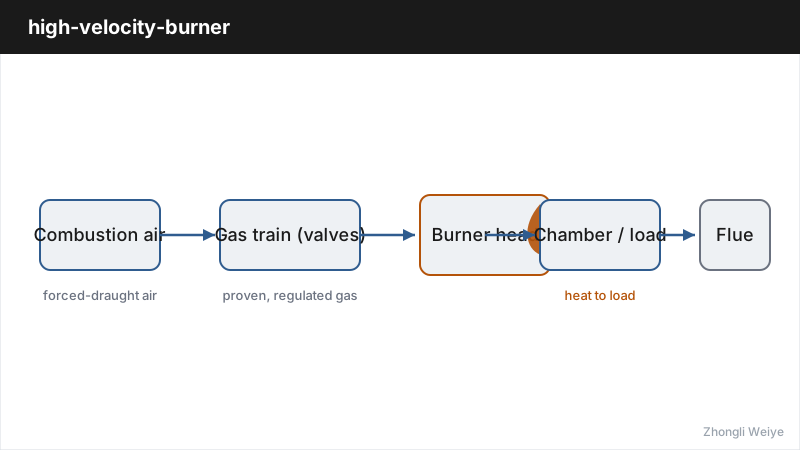
Uniformity is a mixing problem, not a firing problem
A conventional diffusion flame releases most of its heat within a short distance of the burner. Everything beyond that distance depends on convection and on the furnace lining picking heat up and passing it along, which is why a still atmosphere develops hot and cold pockets and why a thermocouple near the burner can read well while the far wall is cold. A high-velocity jet attacks that directly. Its momentum sets up a rotating cell, part of the furnace atmosphere travelling outward along one wall and returning along the other, and the effect is strongest in exactly the places a still flame struggles: far corners, the base of the chamber behind the charge, and the shadow cast by the load itself.
This is why the design shows up in tempering, forging, normalising and reheating work rather than in every furnace. The processes that care about it are the ones where the specification is a spread, not a setpoint. A part that must come out at a band tolerates a gradient across itself far better than it tolerates a gradient from front to back, because the thermal mass smooths short-term variation but does nothing about a chamber that is genuinely colder in one region. Our article on industrial oven burner selection sets out where the alternative firing modes fit.
What the jet costs you at the stack
The same high exit velocity that drives the recirculation carries more sensible heat out of the flue. This is the trade that decides whether the design is worth specifying, and it is worth being blunt about: on a small, already well-mixed chamber the high-velocity arrangement is paying for stirring that was never necessary while exporting extra energy up the stack. The efficiency case only closes when the uniformity it buys is worth something to you, which on a batch furnace with variable loads or frequent door openings it usually is, because the recovered heat from a consistent load outweighs the sensible loss measured on a steady-state test.
Heat recovery changes the arithmetic. A recuperated arrangement takes a substantial share of that flue energy back into the combustion air, and because the jet already entrains and mixes aggressively, the recovered air arrives at the burner well mixed and the flame behaves predictably. The pairing of a strong-turndown jet with recuperation is common for that reason rather than because either half is novel on its own.
Turndown, door openings and the recovery transient
High-velocity burners generally hold a low-temperature soak without flameout, because the jet stabilises the flame root in a way a diffusion flame does not. That strong turndown matters in furnace work more than the headline number suggests, since it is what lets one burner cover both the soak and the peak instead of forcing a low fire through the whole campaign. It also means the burner can follow a setpoint down promptly after a door opening rather than idling far below the flame's stable range.
Recovery after an opening is the case where the stirring earns its place outright. A still chamber loses its uniform temperature first and its total heat second, so it reheats the near burner fast and the far corner slowly. A stirred chamber loses both at the same rate, which shortens the transient and reduces the thermal shock the load sees when the door is shut again. Where a furnace is cycled frequently, that shortened transient is usually worth more than the steady-state number.
Jet geometry, chamber size and furnace pressure
The jet has to have somewhere to go. Fired into an oversized chamber with a long unsupported throw it may never develop the coherent cell that motivated the choice, and the mixing benefit falls away while the stack loss remains. Fired into an undersized chamber the jet impinges on the wall or the load directly, which raises erosion and noise and defeats the even distribution the design exists to deliver. Sizing is therefore a chamber question as much as a burner question, and it is the point at which a catalogue entry stops being enough information.
Chamber pressure is the other geometry variable that gets overlooked. A high-velocity burner moves a lot of gas, and the furnace has to be able to exhaust it without going negative or pressurising the work zone. A weak or oversized exhaust fan fights the burner and gives an unstable firing rate; an undersized one lifts the chamber pressure, which pushes combustion products toward the door seal and makes room pressure unpredictable. Our article on furnace pressure control covers the balance, and combustion air and blower sizing covers the air side that sets the jet velocity in the first place.
Putting it on a control loop without chasing the probe
The jet mixes; it does not measure. Left to a single thermocouple it will happily even out the probe while the corner stays cold, because the probe is a point reading and the process is a distribution. Two or three control thermocouples placed across the charge, combined or averaged so the controller acts on the coldest reading, get closer to the uniformity the design can deliver. A burner program controller handles the firing sequence, and a servo motor on the fuel valve with a damper actuator on the combustion air gives the modulation range the loop needs to actually hold a setpoint.
Watch the air-to-fuel tracking as firing rate changes, because a jet burner with poor air tracking does not simply burn dirty, it loses its cell and stops mixing. That shows up as a uniformity problem rather than an emissions one, and it is why commissioning checks belong on this equipment rather than being assumed from the nameplate. The burner commissioning checklist covers the sequence, and air-fuel ratio tuning covers the trim.
Frequently asked questions
How does a high-velocity burner actually improve temperature uniformity? The fast jet entrains surrounding furnace gas and establishes a recirculating flow, which mixes hot and cold regions together along the length of the chamber. The charge is then heated by well-mixed gas rather than by proximity to the flame, so the spread across the load tightens without any increase in total heat input.
Does a high-velocity burner waste more heat up the flue? It generally does carry more sensible heat out of the stack, because the exit velocity that drives the mixing is the same velocity that carries heat away. Whether that is a penalty or an acceptable trade depends on what the uniformity is worth on your process. On a large or unevenly loaded furnace it usually is worth it, and recuperation recovers much of the difference.
Can it be used with heat recovery? Yes, and the two work well together. The recuperator preheats the combustion air with the exhaust gas, and the aggressive jet mixing means the recovered air reaches the burner well blended, which makes the flame more predictable rather than less. Strong turndown plus recuperation is a common combination for tempering and reheating work.
What happens if I control it from a single thermocouple? You tend to even out the probe rather than the furnace. A point sensor gives a point reading, and the controller will hold that spot on setpoint while the far corners drift. Averaging or combining two or three probes across the charge gets much closer to the distribution the burner can actually deliver.
Does chamber size matter for the mixing benefit? It matters a great deal. Fired into an oversized chamber the jet may not develop a coherent recirculating cell, so the mixing gain is lost while the stack loss remains. Fired into an undersized one it impinges on the wall or the load, which brings erosion and noise instead of even distribution.
Where does it not pay off? Small ovens that are already uniform gain little, and a continuous line with a steady load sees less benefit because the atmosphere is disturbed by the product movement anyway. On those duties the extra sensible loss up the flue is being paid for stirring the process did not need.
Request a quote
If your furnace is fighting temperature gradients or losing heat every time the door opens, send us the chamber volume, the load type and the target band. We will size a high-velocity arrangement and the control loop that keeps it uniform without over-firing, and tell you plainly if a conventional burner would serve the duty better.
Related products
The parts and product families referenced in this guide:
- Gas burner families for jet stirring duty
- Program controller sequencing the firing cycle
- Servo motor giving the loop its modulation range
- Damper actuator holding air-to-fuel tracking as firing changes
- Pressure switches proving the air supply
This guide covers high-velocity firing as a uniformity strategy. For the exact part that fits your duty, send us the model plate photo and we confirm availability, lead time and a matched quotation.